

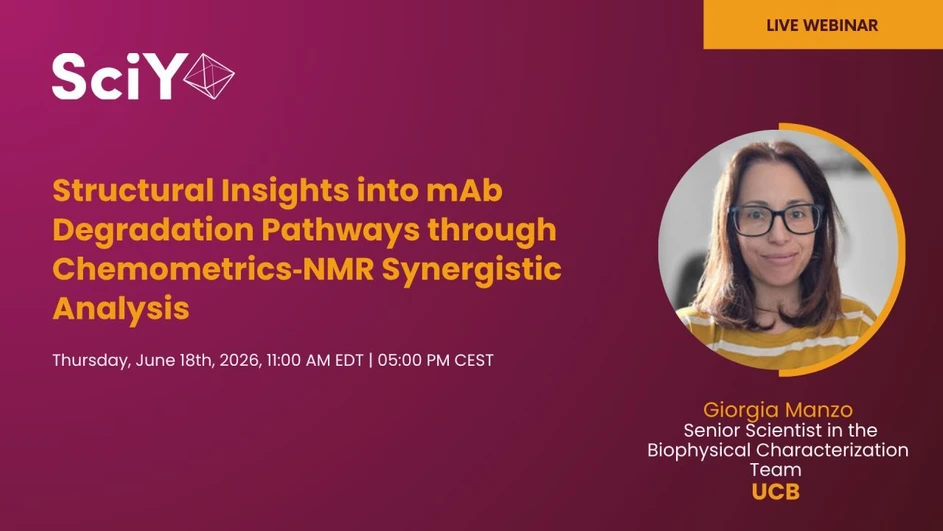
Structural Insights into mAb Degradation Pathways through Chemometrics‑NMR Synergistic Analysis
Forced degradation studies (FDS) are an essential part of therapeutics development. FDS involve the application of stress conditions to therapeutic antibodies to identify Critical Quality Attributes (CQAs) resulting from changes to the antibody Higher-Order Structure (HOS).
NMR, in combination with chemometrics tools provided by the BioHOS plugin in Mnova, was applied to analyze FDS data obtained for two different UCB molecules. The approach identifies pathways involving variations in the molecular correlation time, corresponding to changes in dynamics (e.g., aggregation or fragmentation), and resulting from pathways involving variations at the primary structure level, such as PTMs
Prediction models were then built by using Partial Least Squares (PLS) analysis to predict the degradation pathway caused by the applied stressing condition.
In this webinar, we will be presenting the results from our studies and showing how BioHOS allows to easily identify the NMR peaks driving the main variations, potentially providing a site-specific identification of molecular changes and enabling assessment of the criticality of the CQAs involved.
Learning Points
- How NMR combined with chemometric analysis can be applied to forced degradation studies (FDS) to distinguish different degradation pathways in monoclonal antibodies
- How multivariate models such as PLS help link stressing conditions to changes in dynamics, aggregation, fragmentation, or primary-structure related modifications
- How NMR-based fingerprinting and chemometric loadings can be used to trace degradation effects back to specific spectral regions, supporting higher order structure assessment
Who should attend
- Scientists in analytical development, structural characterization, or biophysical analysis of biologics and biosimilars
- QC, CMC, and comparability teams involved in forced degradation studies and higher‑order structure assessment
- Researchers in pharma, food and beverage, and biotech working with NMR (or other spectroscopic techniques) and multivariate data analysis for proteins or other macromolecules
Speaker: Giorgia Manzo (Senior Scientist in the Biophysical Characterization Team, UCB)
Giorgia studied Biology at the University of Cagliari before completing a PhD in Biophysics on the characterization of antimicrobial peptides with liquid state NMR. After 5 years as post-doctoral researcher at King’s College London, Giorgia joined UCB in 2020 working in the Characterization team as spectroscopy expert. Besides being the reference person for NMR spectroscopy, her fields of expertise cover CD spectroscopy and SPR.


