

Introducing the Compact-Q DEER Spectrometer for Pulsed EPR Distance Measurements
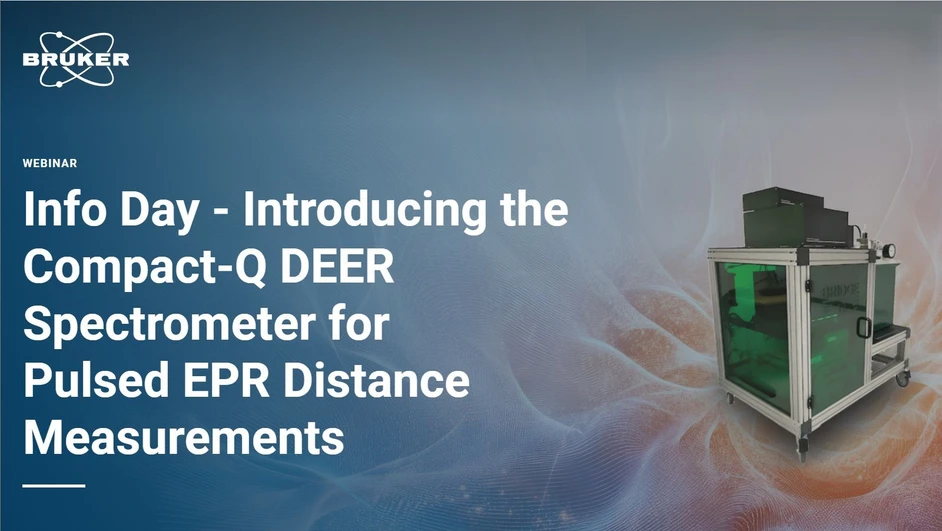
The Compact-Q DEER is a state-of-the-art pulsed EPR spectrometer that offers a versatile platform for pulsed EPR spectroscopy. Featuring modern microwave technology, high-resolution AWG and IQ-mixer based pulse generation architecture, and digital signal processing, it is optimized for EPR based distance measurements (e.g. PELDOR/DEER) while supporting all pulsed EPR experiments.
We will showcase the Compact-Q DEER spectrometer, equipped with a modern tuning scheme using a chirp pulse, reflected power monitor and automated iris control. The system operates at an intermediate frequency of 500 MHz, and the signal is processed using modern digital signal processing (DSP) techniques.
Two-pulse echo decay and field-swept echo experiments will be performed, illustrating ease of use of the instrument. Finally, we will demonstrate DEER distance measurements on a 100 µM nitroxide biradical sample, showing parameter optimization and practical data collection. This session will highlight how the Compact-Q enables high-performance pulsed EPR measurements with an accessible, modern workflow.
What to Expect
This webinar will provide an overview of using the Compact-Q DEER spectrometer for pulsed EPR experiments. We will introduce the acquisition software for experiment setup and data collection, demonstrating its intuitive workflow. Additionally, we will show how to easily set up and run a DEER measurement from tuning to acquisition.
Key Learning Points
Versatility, high-performance and user-friendly operation of the Compact-Q DEER spectrometer will be highlighted along with:
- Resonator tuning scheme using automated iris control
- AWG, digital down conversion and FIR filtering
- Variable gain and bypass-able video amplifiers
- Setting up pulsed EPR experiments, such as a Hahn echo decay, an echo-detected field sweep, and DEER
- Optimizing pulse settings in an efficient manner
- Acquiring high-quality data
Who should attend:
- Undergraduate and graduate students in chemistry, biochemistry, physics, and related fields
- Early-career researchers, postdoctoral fellows, and instrument facility managers new to EPR spectroscopy
- Professors and instructors teaching EPR spectroscopy or related courses
- Industry professionals, scientists, and engineers in chemical, pharmaceutical, and materials science industries
Presenter: Timothy Keller (Ph.D. in physical chemistry from the University of California Santa Barbara, Research Scientist, Bruker)
Timothy Keller holds a Ph.D. in physical chemistry from the University of California Santa Barbara. Since 2019, he has worked as a scientist in the field of magnetic resonance, primarily focused on instrumentation development. His recent work includes the design of microwave resonators for pulsed EPR spectroscopy and the development of microwave bridge hardware for pulsed EPR experiments. His research interests include applying modern microwave technologies to advancing the field of EPR spectroscopy, with a focus on improving sensitivity and enabling new experiments in spin dynamics.
Presenter: Dmitry Akhmetzyanov (Ph.D. in chemistry from Goethe University Frankfurt am Main, Research Scientist, Bruker)
Dr. Akhmetzyanov began exploring EPR spectroscopy during his undergraduate studies at Kazan University, the birthplace of EPR. Throughout his Bachelor’s and Master’s programs, Dmitry’s work centered on applying EPR techniques to materials science. For his Ph.D., Dmitry joined Thomas Prisner’s group at Goethe University Frankfurt am Main, where he focused on development and applications of pulsed EPR dipolar spectroscopy to study structures and dynamics of macromolecules. After his research positions in Germany and Canada, Dmitry joined Bruker in 2024. In the current role as a Research Scientist, he focuses on advancing EPR spectroscopy, developing novel applications, and supporting customers.


