17th European Workshop on Laser Ablation (EWLA 2026)
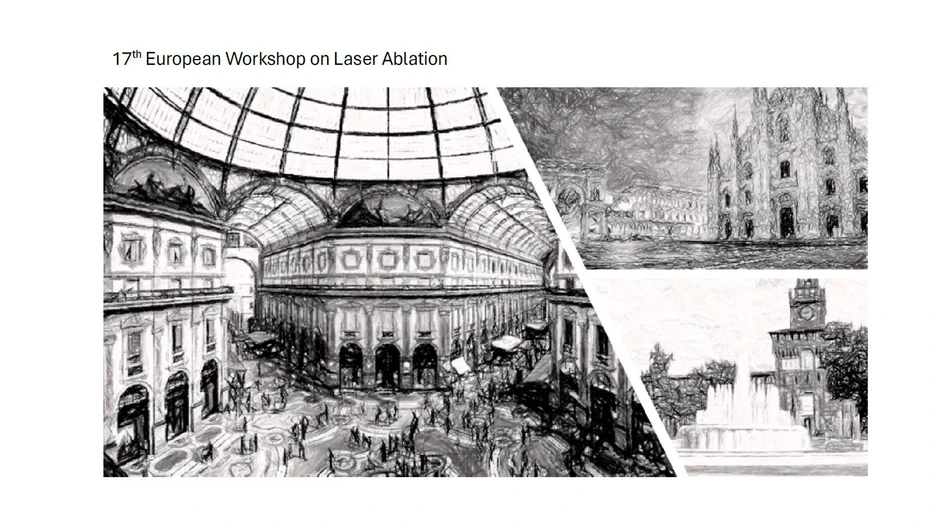
We are pleased to announce the European Workshop on Laser Ablation (EWLA 2026), which will be held in Milan, Italy, from July 7 to 10, 2026. EWLA serves as a platform for scientists, engineers, technicians, and students to share and discuss the latest scientific results, novel concepts, fundamental research, developments, and applications of laser ablation-based techniques across a wide range of scientific disciplines.
Important Dates
- January 1, 2026: call for abstracts
- February 15, 2026: end abstract submission
- March 15, 2026: Notification of abstract acceptance
- February 1, 2026: Start early bird registration
- April 15, 2026: end early bird registration
- June 1, 2026: registration closes
Registration
Registration fees
Early registration
- Full: 450 €
- Reduced*: 280 €
- Accompanying: 300 €
Late registration (After April 15, 2026)
- Full: 550 €
- Reduced*: 380 €
- Accompanying: 400 €
*BSc, MSc and PhD students at the time of EWLA2026
Abstract Submission
You can submit your abstract HERE (at the end of the page)
Abstract Submission Guidelines
Authors are invited to submit abstracts for oral or poster presentations to EWLA Milan 2026.
All abstracts must be written in English and submitted through the online submission system using the official abstract template provided by the conference.
Abstract Requirements
- Maximum length: 450 words (excluding title, authors, and affiliations)
- Format: Abstracts must strictly follow the conference template
- Figures, tables and references: Not allowed
Abstract Content
The abstract should clearly describe:
- the scientific background and objectives
- the methods and analytical approach
- the main results
- the conclusions and perspectives
Information Required at Submission
Presentation Type
- Oral presentation
- Poster presentation
Scientific Session
Authors must select one primary session (and optionally a secondary session):
- Session 1 – Laser–Matter Interaction
- Session 2 – Particle Formation, Transport Phenomena, Standardisation and Data Processing
- Session 3 – Frontiers in Isotopic and Elemental Analysis
- Session 4 – Latest Improvements in Elemental and Isotopic Mapping
- Session 5 – Laser Ablation and Friends: Tandem Analysis and Frontiers in Material Characterisation
- Session 6 – Applications to Earth & Planetary Sciences
- Session 7 – Applications to Life Sciences (A)
- Session 8 – Applications to Material & Environmental Sciences (A)
Title
- Maximum 25 words
Authors and Affiliations
For each author:
- First name
- Last name
- Affiliation(s)
- Country
Please clearly indicate:
- Presenting author
- Corresponding author
Abstract Text
- Maximum 450 words
- Must comply with the official template
Scientific Sessions
FUNDAMENTALS
- SESSION 1: Laser matter interaction
- SESSION 2: Particle formation, transport phenomena, standardisation and data processing
- SESSION 3: Frontiers in isotopic and elemental analysis
- SESSION 4: Latest improvements in elemental/isotopic mapping
- SESSION 5: Laser Ablation and Friends: tandem analysis and frontiers in material characterization
APPLICATIONS
- SESSION 6: Applications to Earth & Planetary Sciences
- SESSION 7: Applications to Life Sciences (A)
- SESSION 8: Applications to Material & Environmental Sciences (A)
Program
Pre-conference Courses
Practical LA-ICP-MS Data Processing with Iolite
- Monday, 6th of July
- Department of Earth Sciences “A. Desio”, Via S. Botticelli 23, Milano
Overview
A hands‑on workshop focused on LA‑ICP‑MS data processing, covering trace‑element analyses, U‑Pb geochronology, and imaging workflows. Emphasis will be placed on best‑practice approaches to calibration, QA/QC, visualisation, and result reporting. The workshop will combine presentations with practical exercises, where participants will be guided through example datasets.
The target audience includes students, researchers, and other practitioners of LA‑ICP‑MS. Only basic LA‑ICP‑MS experience will be assumed. While most example datasets will be geoscience‑focused, the methods covered are equally applicable to bioscience, materials analysis, forensics, and related fields.
Participants will need to bring their own laptops (Windows or macOS) with a charger and, preferably, a separate mouse. A trial version of iolite will be provided, so the ability to install software is required.
Program
Morning (10am – 1pm)
1. Introduction to iolite and LA-ICP-MS/LIBS data processing
2. The iolite v4 User Interface
3. A simple trace elements example to introduce:
- Data import
- Data visualisation
- Selection creation and editing
- Calculating results
- Viewing results
- Exporting data
Afternoon (2pm-5pm)
4. U-Pb Geochronology
5. Image Creation and Image Analysis
6. An introduction to automation
7. Additional resources (e.g. Rb-Sr, Lu-Hf (etc) geochronology tools)
8. Q&A section
9. Wrapup and conclusions
Detailed Program
Tuesday, 7 July 2026
17:00–18:00 PLENARY LECTURE: 35 years of LA-ICP-MS analysis in mineral deposit research – what we have achieved and what we might do next
- Simon Jackson, Duane Petts, Christopher Lawley, Zhaoping Yang
Wednesday, 8 July 2026
Session 1: Laser Matter Interaction
08:30–08:45 Simultaneous detection of elements and molecules using Laser Ablation-ICP-MS/MS
- Takafumi Hirata, Chihaya Kinoshita, Ritsu Morisaki
08:45–09:00 Thermally induced degradation of silica-coated nanoparticles during LA-sp-ICP-MS: wavelength-dependent effects
- Antea Hrepić, Filip Cernatič, Kristina Mervič, Martin Šala
09:00–09:15 (Cryo-)LA-ICP-MS/MS at 157 nm – a progress report
- Wolfgang Müller, Tobias Erhardt, Martin Kutzschbach, Linda Marko, C. Ashley Norris, Michael Shelley
09:15–09:30 Comparison of zircon- and glass-specific ablation effects using single-pulse-resolved LA-ICP-TOFMS
- Sarah Julia Oberholzer, Thibaut Van Acker, Detlef Günther
09:30–09:45 Insights into laser-matter interactions using nitrogen as carrier gas and their implications for LA-ICPMS applications
- Dylan Käser, Joachim Koch, Bodo Hattendorf, Thibaut Van Acker, Detlef Günther
09:45–10:00 Improving the performance of ICP
- Jan Fietzke
10:00–10:30 COFFEE BREAK
10:30–11:00 INVITED: Mapping mineral ion and nanoparticle uptake in plants at the cellular level using LA-ICP-MS and complementary multimodal imaging techniques
- Søren Husted, Daniel Pergament Persson, Francesco Minutello, Andrea Pinna, Tommaso Angeletti, Gustav Krog Søbygaard, Noemi Thiebaut, Grmay Hailu Lilay
Session 2: Particle Formation, Transport Phenomena, Standardisation and Data Processing
11:00–11:15 Measurement errors inherent to the single-particle nature of laser ablation ICP mass spectrometry
- Sota Niki, Takafumi Hirata
11:15–11:30 Recent developments regarding the two-phase transport of non-metals in LA-ICP-MS and its implications for quantification in carbonaceous matrices
- David Ken Gibbs, Lukas Brunnbauer, Andreas Limbeck
11:30–11:45 Li-Rich glass calibration standards for LA-ICP-MS: development, homogeneity and ablation behaviour
- Markéta Holá, Tereza Procházková, Dagmar Galusková, Hana Kaňková, Branislav Hruška, Debora Martha Pötschke, Carla Vogt, Jan Cempírek
11:45–12:00 Ablation characteristics of mica mineral and implications for LA-ICP-QQQ-MS Rb-Sr Geochronology
- Alice MacDonald, Jeffrey Oalmann, Carlos Carrasco Godoy, Ivan Belosouv, Jack Ward
12:00–12:15 The effects of laser spot size and repetition rate on U-Pb systematics
- Carlos Carrasco-Godoy, Jeffrey Oalmann, Ivan Belousov, Sheree Armistead, Alice MacDonald, Jack Ward, Fanghua Dai
12:15–13:30 Light Lunch + Lunch Seminar by Teledyne
- Cryogenic laser ablation: known knowns, known unknowns and unknown unknowns. This lunchtime seminar provides an open forum to build a community around cryogenic laser ablation.
13:30–14:00 INVITED: The evolving art of LA-ICP-MS imaging
- Thibaut Van Acker, Iker Basabe-Mendizabal, Ana Lores-Padín, Mina Nikolic, Aline Pereira de Oliveira, Tom Van Helden, Frank Vanhaecke
Session 7: Applications to Life Sciences
14:00–14:15 AI-enabled correlative imaging reveals thrombus targeting of theranostics
- Michaela Kuchynka, Viktoria Parobkova, Jan Biskupic, Jaroslava Jamrichová, Marcela Vlčnovska, Jana Hlozkova, Peter Scheer, Pavel Bobal, Tomáš Zikmund, Dominik Kočenda, Jakub Vrábel, Pavel Pořízka, Josef Kaiser
14:15–14:30 Correlative elemental and molecular imaging reveals gadolinium deposition patterns in human peripheral nerves
- Hannes Gödde, Hennes Rave, Astrid Jeibmann, Lars Linsen, Uwe Karst
14:30–14:45 Investigation of gadolinium accumulation in neuroinflammation using LA-ICP-ToF-MS
- Heike Traub, Mathias Schannor, Lina Anderhalten, Carmen Infante Duarte
14:45–15:00 Reliable determination of the nanoparticle load on single cells using LA-ICP-TOF-MS and its application in biological research
- Ana Lores-Padín, Mina Nikolic, Thibaut Van Acker, Aline Pereira de Oliveira, Iker Basabe-Mendizabal, Amin Ahmad, Kevin Braeckmans, Frank Vanhaecke
15:00–15:30 COFFEE BREAK
15:30–15:45 Impact of slide material on assessing trace levels of toxic metals in biological tissues using LA-TOF-ICP-MS
- Olga Minaeva, Kevin Kotredes, Juliet Moncaster, Ning Hua, Nicola Lupoli, Paulina Aragay Herrera-Blanc, Gareth Howell, Lee E. Goldstein
15:45–16:00 Metallomic imaging of Tuberculosis-induced Nutritional Immunity
- Alexander P. Morrell, Piotr Golda, Alex Griffiths, Sajid Nadeem, Thrensesan Naidoo, Joel Glasgow, Adrie Steyn
16:00–16:15 Correlating nanoparticle uptake with the cellular landscape of human skin using LA-ICP-TOFMS
- Martin Schaier, Claude Molitor, Gabriel Braun, Paulina Werner, H. Karlsson, Nanna Fyhrquist, Gunda Koellensperger
16:15–16:30 Spatial mapping of transition metals in the mouse spinal cord by high-resolution LA-ICP-ToF-MS imaging
- Emanuela Colombo, Gianluca Sessa, Massimo Tiepolo, Cinthia Farina
16:30 Poster Session
Thursday, 9 July 2026
Session 3: Frontiers in Isotopic and Elemental Analysis
08:30–08:45 Polymer reference materials produced by the LCD 3D printing method and their application in On-chip LA-ID-ICP-MS
- Tianheng Gao, Tongxiang Ren, Panshu Song, Song Wang
08:45–09:00 LA-MICAL-CF-IRMS system for carbonate δ13C and δ18O ultra-microanalysis
- Kimasa Suzumura, Hisashi Asanuma, Toyoho Ishimura
09:00–09:15 Analyzing B isotope ratios in natural waters by LA-MC-ICP-MS as solid evaporite samples
- Michael J. Pribil, Danny L. Rutherford, Jared L. Carte, Shaun J. Donmoyer, Bruce Hensel
09:15–09:30 Lead isotope ratio measurements on ancient silver coins using LA-MC-ICP-MS with a Neoma MS/MS platform
- Philippe Telouk, Marine Pinto, Francis Albarede
09:30–09:45 ²³⁸U–²³⁰Th isotope analysis of GSJ reference rocks by solid nebulization ICP mass spectrometry utilizing the femtosecond laser ablation system with a galvanometric optics
- Saya Kagami, Tatsunori Yokoyama, Sota Niki, Shuhei Sakata
09:45–10:00 SC-550: a sintered calcite reference material for in-situ U-Pb geochronology and strontium isotope analysis
- Lorenzo Tavazzani, Nico Kuter, Felix Marxer, Ismay Vénice Akker, Marcel Guillong, Massimo Chiaradia, Yannick Buret, Dawid Szymanowski
10:00–10:30 COFFEE BREAK
10:30–11:00 INVITED: How far can LIBS imaging go? A journey across scales
- Motto-Ros Vincent
Session 5: Laser Ablation and Friends: Tandem Analysis and Frontiers in Material Characterisation
11:00–11:15 Using Earth data to answer extraterrestrial questions? Case scenario of LIBS
- Jakub Buday, Antony Pawlowicz, Daniel Holub, Jakub Vrábel, Dennis Harries, Pavel Pořízka, Jozef Kaiser
11:15–11:30 Characterisation of black-slipped Hellenistic tableware by LA-ICP-MS and LIBS
- Michael Charlton, Maja Miše
11:30–11:45 Elemental analysis of air-sensitive samples using an inert laser ablation chamber for LIBS & LA-ICP-MS
- Derrick C. Quarles Jr., Hunter B. Andrews, Benjamin T. Manard
11:45–12:00 Laser-based imaging of environmental contaminants and nutrients by Laser-Induced Breakdown Spectroscopy
- Ludmila Čechová, Tomáš Vozár, Jakub Buday, Pavel Pořízka, Jozef Kaiser
12:00–13:30 Light Lunch + Lunch Seminar by Nu Instruments
13:30–14:00 INVITED: From crystals to ages: recent advances in geochronology by Laser Ablation ICP-MS
- David Chew, Kerstin Drost
Session 6: Applications to Earth & Planetary Sciences
14:00–14:15 High precision laser ablation split stream QQQ- and MC-ICPMS trace element and Sr isotopic composition measurements of bio-apatite
- Robert Anczkiewicz, Szymon Mianowski, Maria Dądela, Luca Bondioli, Alessia Nava
14:15–14:30 How to date a dinosaur? Exploring LA-ICP-MS-based U-Pb geochronology on fossil apatite and calcite phases
- Pim Kaskes, Yannick Buret, Ethan R. Tonks, Richard J. Herrington, Susannah C. R. Maidment
14:30–14:45 Distribution analysis of trace elements in refractory inclusions in carbonaceous chondrites using high-spatial-resolution multiple-spot femtosecond LA-ICP-MS
- Yuki Masuda, Kengo T.M. Ito, Sota Niki, Takafumi Hirata
14:45–15:00 Mineral phase-resolved quantification in LA-ICP-MS imaging: from method development to geological applications
- Barbara Umfahrer, Paolo Garofalo, Jiaming Zhou, Jakub Buday, Pavel Pořízka, Jozef Kaiser, Detlef Günther
15:00–15:30 COFFEE BREAK
15:30–15:45 Automated image matching for positioning of sites for LA-ICP-MS geochronology using aSEM-CL images
- Ethan R. Tonks, Yannick Buret
15:45–16:00 Magmatic differentiation and crystal residence timescales constrained by high-resolution zircon ²³⁸U–²³⁰Th geochronology
- Hisashi Asanuma, Hideki Iwano, Yusuke Sawaki
16:00–16:15 Comparing MS/MS MC-ICPMS to ICP-QQQ for in situ Rb-Sr applications
- Kai Rankenburg, Christopher L. Kirkland, Bruno V. Ribeiro, Hugo K.H. Olierook, Bradley J. McDonald, Martin Danišík, Noreen J. Evans
16:15–16:30 Interlaboratory comparison of reference materials for in situ Rb-Sr geochronology
- Alicia M. Cruz-Uribe et al.
16:30 Poster Session
Friday, 10 July 2026
Session 4: Latest Improvements in Elemental and Isotopic Mapping
08:30–08:45 How much can we get from our data? Reconsidering signal detection and aliasing metrics in laser ablation imaging
- Filip Cernatič, Kristina Mervič, Martin Šala
08:45–09:00 Scaling up: towards comprehensive macro-scale elemental mapping with LA-ICP-MS
- Piers Larkman, Remi Dallmayr, Nicolas Stoll, Martin Šala, Hasan Latif, Sebastiano Vascon, Pascal Bohleber
09:00–09:15 Assessing bidirectional scanning in LA-ICP-TOF-MS multielement imaging: capabilities and constraints
- Iker Basabe-Mendizabal, Ana Lores-Padín, Frank Vanhaecke, Thibaut Van Acker
09:15–09:30 A novel coregistration pipeline for multimodal imaging
- Claude Molitor, Lyndsey Hendriks, Max Sinner, Walter Berger, Gunda Koellensperger
09:30–09:45 A silica incorporation strategy for internal standardization in LA-ICP-MS bioimaging of mammalian tissue
- Tobias Schöberl, Beat Aeschlimann, Gunda Köllensperger, Detlef Günther
09:45–10:00 Absolute quantitative imaging strategy of elements and Aβ biomarkers in Alzheimer's disease mice brain by Isotope Dilution Laser Ablation ICP-MS
- Liuxing Feng
10:00–10:30 COFFEE BREAK
10:30–11:00 INVITED: Tracking metal-doped nanoplastics in biological matrices using LA-ICP-TOFMS
- Lyndsey Hendriks, Claude Molitor, Gunda Koellensperger
Session 8: Applications to Material & Environmental Sciences
11:00–11:15 Analysis of microplastics in aqueous particle suspensions by LA-SP-ICP-MS employing a cryogenic ablation cell
- Andreas Limbeck, Elias Foisner
11:15–11:30 Microdroplets for quantification with LA-ICP-QMS: Enhancing the setup for spatially resolved analyses
- Jakob Willner, Maximilian Podsednik, Andreas Limbeck
11:30–11:45 Mitigating cross-talk in LNMO cells: LA-ICP-MS insights into binder-driven transition metal scavenging
- Debora Foppiano, Charifa Hakim, Le Thuy Truong, Martin Šala, Peter P. Molesworth, Nils P. Wagner
11:45–12:00 Segregation and melt-driven redistribution in ns-Laser-Processed Al–Mg alloys revealed by UV-fs-LA-ICP-TOFMS
- Jorge Pisonero, Cristian Soto-Gancedo, Ana Méndez-Vicente, Inés García-Blanco, Joaquín García-Cabezas, Jaime Orejas, Nerea Bordel
12:00–12:15 Accurate, rapid chlorine determination in glass via fs-LA-ICP-MS/MS using H₂ mass-shift mode
- Yoshitaka Saijo, Makiko Murata, Junichi Hirata
12:15–12:30 Rare earth element profiling of microscopic non-metallic inclusions in steel via HT-CSLM surface melting and LA-ICP-MS
- Christoph Walkner, Bernhard Sammer, Kathrin Thiele, Thomas C. Meisel, Susanne K. Michelic
12:30–13:00 Closing Ceremony
13:00 Light Lunch
Venue
The EWLA 2026 will take place in the Ca’ Granda building, one of the most iconic sites of the University of Milan – LA STATALE, located in Via Festa del Perdono 7, 20122, Milano (Italy).