

The 22nd Biennial National Atomic Spectroscopy Symposium (BNASS 2026)
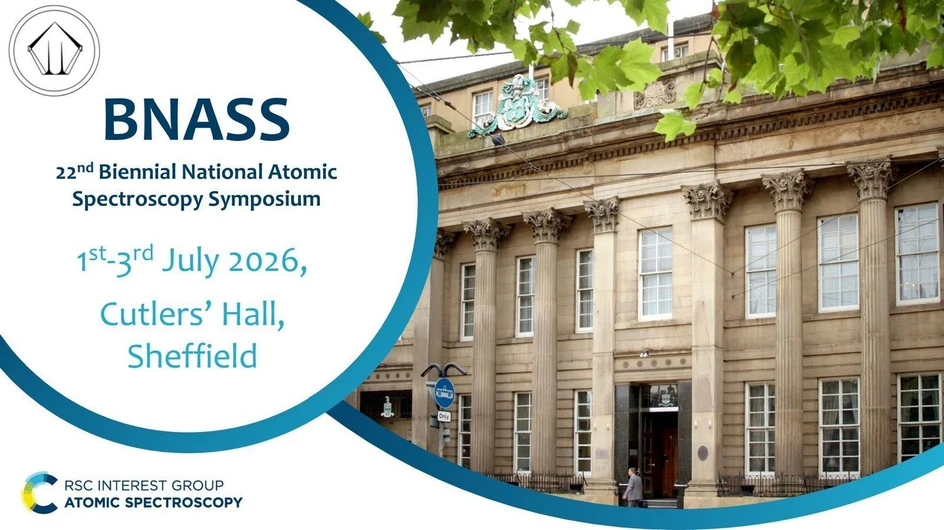
We are very pleased to announce that in 2026 BNASS is returning to the place it all began, the city of Sheffield! BNASS (Biennial National Atomic Spectroscopy Symposium) is the biennial meeting of the RSC Atomic Spectroscopy Group and provides an ideal forum to encourage the exchange of ideas and knowledge in analytical atomic spectroscopy.
These advances have been showcased at BNASS, which has built an international reputation for both the quality of the science presented and the unique style of the symposium, enabling delegates to meet and discuss issues in a social setting. The meeting includes a mix of established and early career speakers, and the organisers would especially like to encourage early career researchers to present their results in short oral presentations within each of the topic sessions.
Our two keynote presentations will be:
Nanoparticles in Foodstuffs: What Single Particle ICP-MS Can (and Can’t) Tell Us
- by Assoc. Prof. Dr Katrin Löschner,
Remobilisation and biotransformations of trace elements in soils
- by Prof. Dr. Adrien Mestrot.
In addition we have the:
Thermo Spectroscopy Award presentation: Boron on the clock: single-cell ICP-MS reveals rapid BNCT kinetics
- by Dr James Coverdale.
Important Dates
- Mar 31 2026: Oral abstracts deadline
- Mar 31 2026: Poster abstract deadline
- May 22 2026: Early bird registration deadline
Registration
Registration fees
- RSC Member: £335
- RSC Student Member: £150
- Non-member: £410
- Non-member: Student £250
Early bird fees until 31st May 2026, after which it will cost £100 more per fee.
All social events included in the registration fee (to be announced soon).
Abstract Submission
Program
Wednesday 1st July
12:30–13:30 Registration and Lunch
13:30–13:45 Opening Ceremony: History and significance of Cutlers’ Hall
13:45–14:00 Welcome address: BNASS 2026 Organising Committee
Session 1: Environmental Applications and Sustainability
14:00–14:40 Arsenic and antimony in soils and beyond. Novel sampling and speciation techniques, fieldwork and laboratory incubations help shed light into less studied parts of their biogeochemical cycle
- Keynote Speaker: Adrien Mestrot (University of Bern, Switzerland)
14:40–15:00 Plant Powered Purification: Sorption of Arsenic and Chromium by using Tannic acid-Sodium Alginate Hydrogel beads
- Aiman Rizvi (University of Strathclyde, UK)
15:00–15:20 Ion beam analysis of passive bio-indicators for probing traffic-related pollution along an urban-rural gradient from Guildford to Greater London
- Pierre Couture (University of Surrey, UK)
15:20–15:50 Refreshment Break
15:50–16:10 Sensitivity vs. Robustness
- Platinum Sponsor: Clement Elliott (Shimadzu, UK)
16:10–16:30 Improving the Sustainability of Trace Element Analysis through Plastic Sample Vial Re-use
- Christine M. Davidson (University of Strathclyde, UK)
16:30–16:50 Enabling the recycling of technology critical elements from e-waste to support the circular economy
- Sarah Hill (LGC, UK)
16:50–17:20 Lightning Poster Talks
17:20–18:00 Networking in the Exhibition Hall
18:30 Group walk to Riverside (evening social event/meal venue)
19:00 Evening Social Event – BBQ and quiz at the Riverside
Thursday 2nd July
Session 2: Nano- and Microparticles
09:30–10:10 Nanoparticles in Foodstuffs: What Single Particle ICP MS Can (and Can’t) Tell Us
- Keynote Speaker: Katrin Löschner (Technical University of Denmark, Denmark)
10:10–10:30 Nanotoxicology of metals: Environmental monitoring and biomonitoring of metal nanoparticles in welders
- Tatiana Pedrazzi (University of Brescia, Italy)
10:30–10:50 Gaining a deeper understanding of multi-dimensional nanoparticle data using Uniform Manifold Approximation and Projection (UMAP) and Hierarchical Density-Based Spatial Clustering of Applications with Noise (HDBSCAN)
- Phil Shaw (Nu Instruments, UK)
10:50–11:20 Refreshment Break
11:20–11:40 Desorption of Cd, Cr and Pb from polyamide-6, poly(ethylene terephthalate) and polypropylene microplastics
- Invited Speaker: Bamikole Walter Osungbemiro (University of Strathclyde, UK)
11:40–12:00 Application of element ratio and isotope ratio measurement to ambient particulate matter samples
- Emma Braysher (National Physical Laboratory, UK)
12:00–12:20 From lectures to investigations: project-based teaching of spectroscopy concepts to inspire future analytical chemists
- Shaun Lancaster (University of Leoben, Austria)
12:20–14:00 Lunch
13:10–14:00 ESI Event
Session 3: Methodological Developments
14:00–14:20 Optimising ICP-MS Analysis: Enhancing Helium Collision and Reaction Cell Modes
- Platinum Sponsor: Sonia North (Agilent Technologies, UK)
14:20–14:40 Expressing the agreement between the measured value and the certificate value: A closer look at the t-test
- Julian Tyson (University of Massachusetts, USA)
14:40–15:00 The development of a GC-ICP-MS interface for the analysis of bromine VOCs
- Claire Richards (University of Loughborough, UK)
15:00–15:20 Iodine in Biological Media using ICP-MS: Challenges and Perspectives
- Nikolay Solovyev (Atlantic Technological University, Ireland)
15:20–15:50 Refreshment Break
15:50–16:10 From Sampling to Analysis: Measuring Trace Contaminants in Biogas
- Ayush Agarwal (Paul Scherrer Institute, Switzerland)
16:10–16:30 Developing mass spectrometry-relevant low level radioactivity standards: Results from a European comparison exercise and future developments
- Ben Russell (National Physical Laboratory, UK)
16:30–16:50 Development of hyphenated techniques with ICP-MS for medical radionuclide separation and detection
- Jenny Laird (National Physical Laboratory, UK)
16:50–18:00 Poster Session and Drinks Reception
18:30 Conference Dinner at Cutlers’ Hall (food served from 19:00)
21:00 Live music (Take the Seven) and bar at Cutlers’ Hall
Friday 3rd July
Session 4: Biological Applications
09:30–10:00 Boron on the clock: single-cell ICP-MS reveals rapid BNCT kinetics
- Invited Speaker: James Coverdale
10:00–10:20 Quantifying Iron in Immune Cells by sc-ICP-MS
- Philip Holdship (University of Oxford, UK)
10:20–10:40 Using spatiotemporal metallomics and transcriptomics to identify novel therapeutic targets for diabetic wound repair
- Alice Fearn (University of Hull, UK)
10:40–11:10 Refreshment Break
11:10–11:30 LA-ICP-MS Analysis of ‘Empty’ Fingermarks Developed using Vacuum Metal Deposition: A Preliminary Investigation
- Rachel Dennis (Loughborough University, UK)
11:30–11:50 3D multi-modal imaging of germinating barley
- Olivia Doolan (Sheffield Hallam University, UK)
11:50–12:10 The effect of arbuscular mycorrhiza on zinc phytoavailability, uptake and translocation in rice: a pilot natural stable isotope investigation
- Rebekah Moore (Imperial College London, UK)
12:10–12:30 Prizes and Final Remarks
- BNASS Organising Committee
12:30 Lunch and depart
Sponsors and Exhibitors
- Elemental Scientific Inc
- Qmx
- Agilent Technologies
- Shimadzu
- Anton Paar
- Thermo Fisher Scientific
Venue
The Cutler's Hall
- The Cutler's Hall, 7-15 Church Street , Sheffield , S1 1HG, United Kingdom


