

RAFA 2026
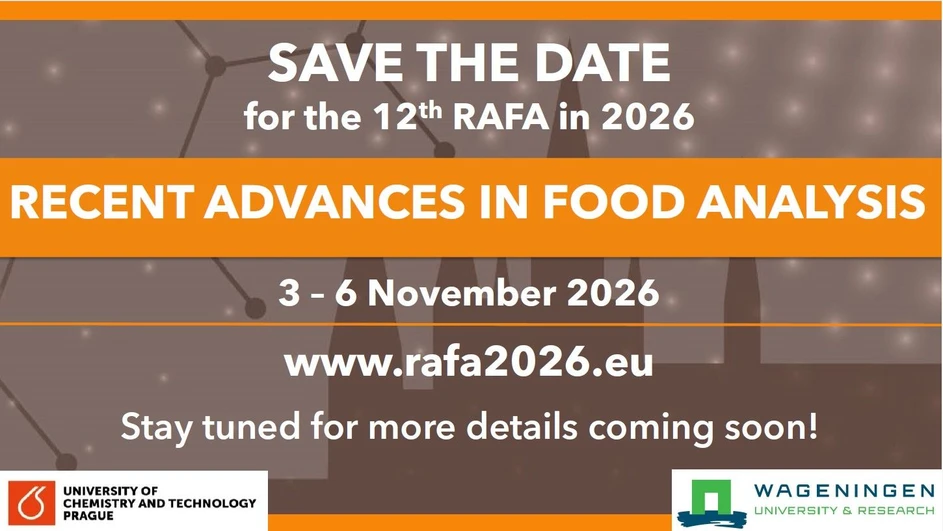
On behalf of the University of Chemistry and Technology, Prague (UCT Prague, Czech Republic) and Wageningen Food Safety Research (WFSR), part of Wageningen University & Research (The Netherlands) we are delighted to invite all food scientists from academia and industry, and representatives of national and international agencies, control authorities, governmental and commercial laboratories to attend the 12th International Symposium on Recent Advances in Food Analysis (RAFA 2026).
The organizers of the RAFA 2026 plan to prepare a balanced programme including oral presentations given both by invited speakers, researchers and young scientists, satellite workshops, interactive and vendor seminars, extensive poster sessions and nice social events.
We are looking forward to meeting you again in beautiful Prague!
- Prof. Jana Pulkrabova & Dr. Stefan van Leeuwen, Symposium Chairs
- Prof. Michele Suman, Symposium Co-chair
- Prof. Jana Hajslova & Prof. Michel Nielen, Symposium Honorary chairs
Key dates
- May 31, 2026: Application for Young scientist travel grant
- June 30, 2026
- Application for participation as a Sponsor or Exhibitor or Media partner
- Abstract submission for oral presentation
- Reduced registration fee
- August 31, 2026: Abstract submission for poster presentation
- September 30, 2026: Last minute posters submission
In line with the concept of the previous events, RAFA 2026 Symposium will provide an overview of contemporary trends in the ANALYTICAL & BIOANALYTICAL STRATEGIES IN FOOD QUALITY AND SAFETY CONTROL and discuss the CHALLENGES AND NOVEL APPROACHES IN FOOD AND NATURAL PRODUCTS ANALYSIS. Following RECENT & EMERGING ISSUES will be addressed in the RAFA 2026 sessions:
- Alternative proteins
- Biologically active compounds
- Environmental contaminants
- Flavour & off-flavours
- Food additives, flavourings
- Food allergens
- Healthy nutrients & vitamins
- Metals & metalloids, including their speciation
- Micro- and nanoplastics in food
- Migrants from food packaging materials
- Mycotoxins, plant alkaloids and other natural toxins
- Pesticide & veterinary drug residues
- Per- and polyfluoroalkyl substances (PFAS)
- Process induced contaminants
- Psychoactive and psychomodulation compounds
- Artificial Intelligence in food analysis
- Exposomics & Human biomonitoring
- Food authenticity, fraud and forensics
- Food legislation requirements for food control
- Illegal and natural food supplements
- (Multi)omics in food analysis
- NAMs (New Approach Methodologies)
- Next generation effect-based analysis & Bioassays
- Next generation sequencing for food quality and safety
- Novel analytical approaches
- QA/QC, Chemometrics & Big data handling
- Sensors & Portable food analysis
- Sharing is caring: making tools and databases available for analytical food research
- Sustainability & Green food analysis
Registration
Registration for RAFA 2026 is OPEN!
Early-bird registration until 30 June, 2026
After successful submission of your registration, you will receive by e-mail (i) an automatic confirmation of receipt indicating the total amount of payment due (either for bank transfer or for on-line payment by card), (ii) login to Member section where you can administrate your profile, submit your abstracts, and from September 2026 register for satellite events, workshops and seminars. If it will not be delivered within a few minutes after submission of your registration please contact us at [email protected].
As soon as payment of registration fee is processed, you will also receive by e-mail (iii) confirmation of payment.
Important notice:
Registration fee of those who have submitted an abstract for oral or poster presentation has to be received until September 30, 2026, otherwise these contribution(s) will not be included into the Book of Abstracts and the Conference programme.
The regular registration fee will include:
- Attendance at all scientific sessions, workshops, seminars, vendor seminars and other satellite events
- Access to the poster and exhibition area
- Conference kit (name badge, conference bag, conference documents, certificate of participation, certificate of presentation on request)
- Final programme
- E-Book of Abstracts
- Coffee breaks
- Buffet luncheons
- Welcome drink
In the registration form you can register free of charge for the welcome drink and you can also order ticket(s) for the conference dinner (€ 85).
Please note that your registration is firm when your payment has been received.
Registration Fees
- Smart rate (Until 30 June, 2026): € 655
- Regular registration (Until 30 September, 2026): € 855
- Late registration (From 1 October, 2026): € 955
- Student rate*
- Until 30 June, 2026: € 465
- From 1 July, 2026: € 605
* The proof of student status (e.g. copy of a student identify card) is requested as an attachment of the registration form.
Abstract submission
In order to submit an abstract, you must first register to attend RAFA 2026. After registration you will receive an access to the Member section where you can submit your abstract(s).
After successful submission of your abstract you will receive an automatic confirmation of receipt of submitted abstract via e-mail. If it will not be delivered within a few minutes after submission of your abstract please check at first your spam box-mail and then contact us at [email protected].
Please ensure that your abstract does not contain spelling, grammatical or scientific errors. Even though modifications of your submitted abstract will be allowed in the Abstract section of the Member section until the deadline for the abstract submission, please be confident on the lack of errors in your final version prior to starting the submission process.
The abstract will be reproduced exactly as submitted. No proofreading will be done, although some corrections may be requested by the reviewers.
If you need to withdraw your abstract, a written statement reflecting the reasons for this decision must be sent to [email protected] no later than September 30, 2026.
Important notice:
1 registered participant can submit no more than 2 abstracts.
To apply for a young scientist’s oral presentation, as an indication please respect the rule that you should be born in 1991 or later.
The text of the abstract should be limited to 3000 characters including spaces. Tables and pictures are not allowed.
Abstracts of oral presentations and posters will be included into the "e-Book of Abstracts" only after receipt of the conference registration fee. Any payment of the registration fee has to be received until September 30, 2026, otherwise contribution(s) will not be included into the e-Book of Abstracts and the Conference programme.
Poster award
The best poster presentation(s) will be awarded with the prestigious RAFA Poster Award and sponsored poster awards.
Poster and oral presentation instructions
Guidelines for poster presentation
- The poster presentation is an effective way to communicate your research to colleagues. It has become the "presentation of choice" for many scientists who present at RAFA.
Guidelines for oral presentation
- Oral presentations will require a Microsoft Office PowerPoint format and should be submitted at the symposium on a USB memory stick.
Program
Invited speakers
It takes a small step to fake food but a giant leap to authenticate
- Dr. Nicolai Zederkopff Ballin (Danish Veterinary, Food, Agriculture and Fisheries Agency, Denmark)
“It takes a small step to fake food but a giant leap to authenticate”: Exploring unresolved issues in food authentication Food authentication includes not just analytical chemistry, but also nomenclature, validation procedures and reporting of results. These aspects have attracted increasing focus, but setting limits in food authentication has been largely absent. It is therefore time to discuss how to set maximum tolerable limits to enable consistent and comparable results in food authentication.
Unravelling the mysteries of modified mycotoxins
- Assoc. Prof. Dr. Franz Berthiller (BOKU University, Vienna, Austria)
Modified mycotoxins are altered forms of mycotoxins, mainly formed by living plants on the field. They are not regulated, yet may contribute to toxicity. The presentations focuses on metabolites of fumonisin B1 and ochratoxin A, formed by maize plants.
An overview of the latest scientific knowledge on process contaminants in food for appropriate risk management measures
- Dr. Thierry Delatour (Nestlé Research, Lausanne, Switzerland)
Recent scientific findings related to acrylamide and furans formation, occurrence and analytical methods in food provide important insights for risk management.
Never-ending analytical challenges in PFAS analysis of food
- Assoc. Prof. Darina Dvorakova (University of Chemistry and Technology Prague, Prague, Czechia)
Exploring and monitoring PFAS in food requires advanced strategies.
Combining targeted, suspect, and non-target HRMS analysis, determination of total fluorine and sum parameters, and novel sensors provides new insights into PFAS occurrence and supports food safety monitoring.
Challenges of microplastics analysis in the context of food safety
- Dr. Dorte Herzke (Norwegian Institute of Public Health, Oslo, Norway)
Food and food packaging are major sources of micro- and nanoplastic exposure. Plastics used in processing, storage, and packaging can release particles through heat, abrasion, and degradation. Small particles of below 2 µm may cross gut barriers and carry chemicals, highlighting the need for robust and sensitive measurement methods.
Data-driven strategies to reduce complexity in non-target HRMS analysis of food samples
- Prof. Anneli Kruve (Stockholm University, Stockholm, Sweden)
LC/HRMS based non-target screening can detect hundreds to thousands of chemical features in complex food and environmental samples. Investigating all of these in detail is practically impossible, so which ones to focus on? Novel computational tools developed in computational mass spectrometry allow predicting the toxicity and concentration of the detected chemical features even if these have not yet been fully structurally elucidated. Combining these predictions enables us to focus on the chemical features possessing high risk.
Imaging food: the power and the limits of seeing molecules in food
- Dr. Laura Righetti (Wageningen University & Research, Wageningen, the Netherlands)
Imaging techniques enable ‘seeing’ molecules in food and elucidating mechanisms of accumulation and transformation, e.g. during processing. However, their application to food and contaminants remains limited. This talk discusses both instrumental constraints and future opportunities.
Sample-to-solution approaches for natural toxin analysis at the point of need
- Dr. Gert Salentijn (Wageningen University & Research, Wageningen, the Netherlands)
Taking analysis out of the lab is not trivial. Going beyond merely translating procedures from the lab to an out-of-lab setting, it requires a fundamentally different perspective on how we develop and deploy the tools to provide information at the point-of-need. In this, both the envisioned test, as well as the envisioned user are critical, and all the steps, from sample to solution, need to be considered.
Comprehensive strategies to unmask masked mycotoxins: from food matrix to gut microbiota
- Prof. Milena Stranska (University of Chemistry and Technology Prague, Prague, Czechia)
The lecture will address non-extractable modified mycotoxins and their biological relevance. Bioaccessibility will be assessed using in vitro digestion models with diverse fecal microbiota (toddlers, children, adults) and bioavailability using Caco-2-based intestinal models. High-resolution mass spectrometry will reveal biotransformation pathways and cellular metabolism of free and modified mycotoxins.
Recent developments and outlook of EU policy in food on contaminants with a focus on related analytical challenges
- Dr. Frans Verstraete (European Commission DG Health and Food Safety, Brussels, Belgium)
In the European Union, the presence of many contaminants in food are regulated to ensure a high level of human health protection. A key element for the effectiveness of the EU policy is the enforcement of the maximum levels. For an effective enforcement it is indispensable that methods of analysis are available that provide reliable results and that can be applied by laboratories on a routine basis. However, besides confirmatory methods and to enable a high frequency of controls, the availability of reliable and validated semiquantitative or qualitative screening tools is a must!
SPECIAL OPPORTUNITIES FOR YOUNG SCIENTISTS
- Ample space reserved in the main program for oral presentations given by young researchers
- Award(s) for the best poster presentation(s)
- RAFA 2026 competitive travel grants for young scientists
SATELLITE EVENTS, SEMINARS AND WORKSHOPS
Workshops on novel challenges:
- Workshop on “Vibrational spectroscopy and chemometrics”
- Experts from the Walloon Agricultural Research Center in Belgium will organize traditional workshop designed to equip participants with basic and advanced knowledge in vibrational spectroscopy and chemometrics.
- Workshop on “Smart data handling and AI in food analysis”
Interactive seminar – Be active and learn from each other:
- Step by step strategies for a fast development of smart analytical methods
Interactive demonstration of general approaches to fast development and troubleshooting in laboratory focused on food quality and safety control will be provided. The moderators will introduce interesting real-life case studies with various conceivable scenarios for each step in the method development (including both sample preparation and instrumental analysis) and/or for each troubleshooting problem. Attendees will be invited to identify the most suitable solution using an anonymous online voting; discussion about each presented option will follow. Attendees will have a possibility to check their knowledge, present their experience and, last but not least, win special prizes by participating in a short quiz.
Experts´ summit, EU and beyond:
- Session by AOAC INTERNATIONAL and ILSI Europe “Harmonizing Methods and Managing Risk: A Food Industry Perspective”
EC Reference Laboratories colloquium:
- Workshop on “Experiences, achievements and challenges by EU Reference Laboratories”
The workshop will focus on sharing practical insights, key accomplishments, and current challenges faced by EU Reference Laboratories. Participants will explore best practices, innovative approaches, and issues related to harmonization across member states. The sessions will also provide a platform for discussion, collaboration, and identifying future opportunities for strengthening this essential European infrastructure.
Workshops & Sessions on EU Framework Programs and other projects:
- Workshop on “Opportunities to collaborate in a European research and innovation area”
The workshop will provide an overview of opportunities for food scientists to participate in the Horizon Europe programme. This workshop will be organised as a side event of RAFA 2026, for free.
Vendor seminars & Exhibition:
- Vendor seminars introducing recent progress instrumentation and analytical strategies
- Exhibition of state-of-the-art instrumentation, laboratory equipment, screening tests, standards/reference materials, and consumables used in food analysis
Venue
The RAFA 2026 symposium will be organised in the Clarion Congress Hotel Prague, the international four-star hotel and a state-of-the-art congress centre providing high quality services for hosting variety of events.
The conference centre is located in close proximity of one of underground lines (yellow line "B", metro station "Vysocanska") with very frequent services to the Prague city centre of Prague (15 - 20 min) and to the airport (50 – 60 min by bus and metro).
Address of the venue:
- CPI Hotels, a.s.
- Clarion Congress Hotel Prague****
- Freyova 33
- 190 00 Prague 9 – Vysocany
- Czech Republic


