16th International Conference on Advanced Materials Research (ICAMR 2026)
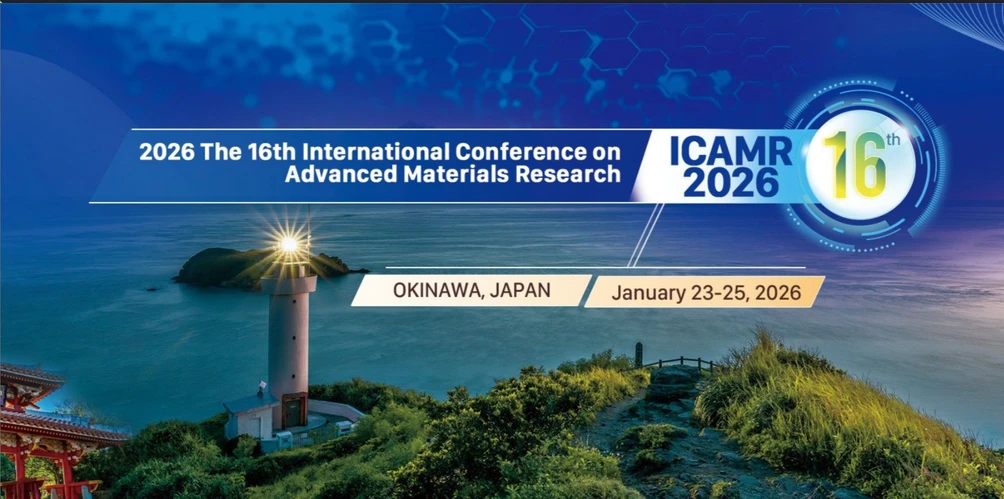
ICAMR is an annual conference launched in the year of 2011. We had this conference successfully held in Bali 2025, Phuket Island 2024, Singapore 2023, Online 2022-2022, Okinawa, Japan 2020, Singapore 2019, Fukuoka, Japan 2018, Hong Kong 2017, Torino, Italy 2016, Doha, Qatar, 2015, Macau, 2014, Dubai, UAE in 2013, Chengdu, China in 2012 and Chongqing, China in 2011. It will provide a valuable opportunity for researchers ,scholars and some scientists to exchange their ideas face to face together. ICAMR is very special for its strong organization team, dependable reputation and wide sponsors all around the world, which is the leading annual conferences of Materials Sciences for all researchers home and abroad.
ICAMR 2026 will include the participation of renowned keynote speakers, oral presentations, posters sessions and technical conferences related to the topics dealt with in the Scientific Program.
Important Date
Submission Deadline
- Full Paper / Publication: September 05, 2025
- Abstract / Presentation only: September 05, 2025
Registration Deadline
- October 20, 2025
Notification Due
- Full Paper / Publication: Within October 05, 2025
- Abstract / Presentation: Five Working Days
Camera Ready
- December 30, 2025
Registration
Register HERE
Registration fees
Delegate Registration - Before October 25
- Normal participants: 300 USD
- Student participants: 250 USD
- Group registration: please mail [email protected]
Delegate Registration - After October 25
- Normal participants: 320 USD
- Student participants: 280 USD
- Group registration: please mail [email protected]
Registration Includes
- Admission to all sessions
- Certificate, Name tag, Conference bag, Souvenir
- Lunches, coffee breaks and Dinner
- Conference Schedule/Abstracts
To Register as Delegate
- Please fill the form online and make the payment.
- Please mail [email protected] to finish your registration.
- The conference secretary will feed you back with registration confirmation.
- For payment methods (bank transfer or pay pal account), please mail [email protected]
Registration Onsite
- You can make the payment onsite the conference. But we will just offer you the presenter's certificate with handwriting instead of printing.
- Note: it could be better to register in advance. So all materials can be prepared for you.
- Any questions, please mail conference secretary Celine.
Abstract submission
Topics of interest for submission include, but are not limited to:
Composite Materials
- Metal Matrix Composites, Ceramic Matrix Composites, Polymer Matrix Composites, Concrete and cementitious composites,Damage and fracture, Durability and ageing, Experimental techniques, Fibers and matrices, Interfaces and interphases, Interlaminar reinforcements, Joint and bearing behaviour, Life cycle analysis and sustainability, Low cost technologies, Mechanical and physical properties, Metal matrix composites, Multifunctional composites, Multiscale modelling, Nanocomposites
Materials Properties, Measuring Methods and Applications
- Ductility, Crack Resistance, Fatigue, Creep-resistance, Fracture Mechanics, Mechanical Properties, Electrical Properties, and Magnetic Properties, Corrosion, Erosion, Wear Resistance, Non-Destructive Testing, Reliability Assessment, Toxicity, Working Properties of Materials and Products, Large Scale Applications, Electronics Applications
Materials Science and Engineering
- Metallic Alloys, Tool Materials, Superplastic Materials, Ceramics and Glasses, Composites, Amorphous Materials, Nanomaterials, Biomaterials, Multifunctional Materials, Smart Materials, Engineering Polymers, Functional materials, Nuclear fuel materials, Biomaterals, sensors and surfaces, Thin Film Chalcogenide Photovoltaic Materials, Nuclear Materials IV, Magnetic Materials, Multi Functional Magnetic Materials, Superconducting Materials, Structured Materials, Spintronics Materials and Devices, Hard/Soft Magnetic Materials, Crosscutting materials
Materials Manufacturing and Processing Technologies
- Casting, Powder Metallurgy, Welding, Sintering, Heat Treatment, Thermo-Chemical Treatment, Thin & Thick Coatings, Surface Treatment, Machining, Plastic Forming, Quality Assessment, Automation Engineering Processes, Robotics, Mechatronics, Technological Devices and Equipment, Theoretical Fundamentals of Cleaner Production, Industrial Application of Cleaner Production Methods, Production Planning and Control
Chemical Engineering and Biotechnological Research
- Bio-based composites, Biomimetic composites, Bioprocess, etc
Nanotechnology, Nano-Materials and Nano-Composites
- Different Methods for Growth of Nanostructures, Characterisation of Nanomaterials, Organic,Inorganic,and Biomedical of Nanomaterials, Different Kinds and Morphologies of Nanostructures: Metal and Metal Oxide of Nanoparticle,Nanowires and Nanorod,Carbon Nanotube and Graphene, Nanostructured Thin Films and Coatings, Nanocomposites, Doped Nanomaterials, Nanostructured Ceramic Mechanical,Thermal,Electrical,Optical and Magnetic Properties of Nanomaterials, Modification of Nanomaterials, Nanoengineering
Thin Films Research
- Silicon-based materials, Chalcogenidesemiconductors, Nanostructures organicmaterials dye-sensitized photoelectrochemical cells, Hybrid solar cells, Nanostructures Obtained Using Electric Discharges, Graphite Films Deposited on Metal Surface by Pulsed Electrical Discharge Machining, Thin-Film Photovoltaic Devices, Structural and Physical Properties of thin Films
Methodology of Research and Analysis and Modelling
Electron Microscopy, X-ray Phase Analysis, Metallography, Quantitative Metallography, Image Analysis, Computer Assistance in the Engineering Tasks and Scientific Research, Numerical Techniques, Statistic Methods, Residual Life Analysis, Process Systems Design, Mould Flow Analysis, Rapid Prototyping, CAM, CAMS, CAQ, Engineering Design, Technological Design, Materials Design, Computational Material Science, Materials and Engineering Databases, Expert Systems, Artificial Intelligence Methods
Submitted papers will be reviewed by committee reviewers and be scheduled for either oral or poster presentation during the conferences if the topic is relevant and the quality of the data justifies scheduling. Irrelevant or poor-quality papers may be rejected. Reviewed and accepted papers will receive notification information via email on Notification day, and will be requested to register before the Registration Deadline.
How to Submit your paper?
- Please send your paper/abstract to Online Submission System; (.pdf only)
https://www.zmeeting.org/submission/icamr2026 - An account is needed. If you do not have, please apply it first.
Submission Type
- Full Paper (Presentation and Publication) (Template)
- Accepted full paper will be invited to give the oral presentation at the conference and be published in the Key Engineering Materials (ISSN: 1662-9795), indexed by SCOPUS, REAXYS, Inspec (IET, Institution of Engineering Technology), Chemical Abstracts Service (CAS), Google Scholar, etc. (Index information is from the KEM official website)
- Page Limit: Each paper should be more than 4 full pages normally, including all figures, tables, and references.
- Extra Page: The first 6 pages are free, Extra pages will be charged at $50 (US dollars) per extra page
- Abstract (Presentation only) (Template)
- Accepted abstract will be invited to give the oral or poster presentation at the conference, and it can be included in Program only.
- Delegate
- Please fill the form online, pay the fee and mail to [email protected] to finish your registration.
- Groups &Team &Sponsors
- Groups&Team&Sponsors are welcome, please contact with [email protected] for details.
- Workshops and Tutorials
- Please mail Ms. Ashily Qi via mail address [email protected]
Tentative Program
January 23, 2026 | Friday
10:00-17:00 Registration, collecting conference materials and online test
January 24, 2026 | Saturday
09:00-09:10 OPENING REMARKS
09:10-09:55 KEYNOTE SPEECH I
09:55-10:40 KEYNOTE SPEECH II
10:40-11:20 GROUP PHOTO& COFFEE BREAK
11:20-12:00 KEYNOTE SPEECH III
12:00-13:30 LUNCH
13:30-18:00 PARALLEL SESSIONS
January 25, 2026 | Sunday (Pending)
09:00-12:00 PARALLEL SESSIONS
12:00-13:30 LUNCH
13:30-17:00 PARALLEL SESSIONS
Conference Speakers
Waveguide-type Optical Nonreciprocal Devices for Si Photonics
Abstract
In optical communication systems, optical nonreciprocal devices, such as optical isolators or optical circulators, are indispensable in protecting active photonic devices from unwanted reflected light. In the near infrared region, magnetic garnet crystals are necessary for constructing optical nonreciprocal devices owing to their transparency and large magneto-optic coefficient. The author has investigated an interferometric optical isolator by using a nonreciprocal phase shift. The nonreciprocal phase shift occurs in transverse magnetic modes that travel in magneto-optic waveguides in which magnetization is aligned transverse to the light propagation direction in the film plane. The optical isolator employing the nonreciprocal phase shift is attractive because there is no need for phase matching or complicated control of the direction of magnetization. The author’s group demonstrated the nonreciprocal phase shift in the magneto-optic waveguide with a magnetic garnet guiding layer. The author’s group also demonstrated the nonreciprocal phase shift in the magneto-optic waveguide with a GaInAsP guiding layer fabricated by wafer bonding technique. In 2003, the author proposed an optical isolator with a Si guiding layer. Since then, many research groups have investigated optical isolators with a Si guiding layer for Si photonics. The author introduces waveguide-type optical isolators employing the nonreciprocal phase shift. Calculated nonreciprocal phase shifts of magneto-optic waveguides with various layer structures are discussed.
Prof. Hideki Yokoi (Shibaura Institute of Technology, Japan)
- Hideki Yokoi received the B.E. (1989), M.E. (1991), and D.E. (2000) degrees in physical electronics from Tokyo Institute of Technology. He is a professor, College of Engineering, Shibaura Institute of Technology. His current interests include optical nonreciprocal devices, photonic integrated circuits, optical fiber sensors, and optofluidic sensors.
Venue
Pacific Hotel Okinawa(パシフィックホテル沖縄)
- Address: 3 Chome-6-1 Nishi, Naha, Okinawa 900-0036, Japan (〒900-0036 沖縄県, 那覇市, 西3丁目6番1号 )
- Web: https://pacifichotel.jp/