21st Raman Imaging Symposium
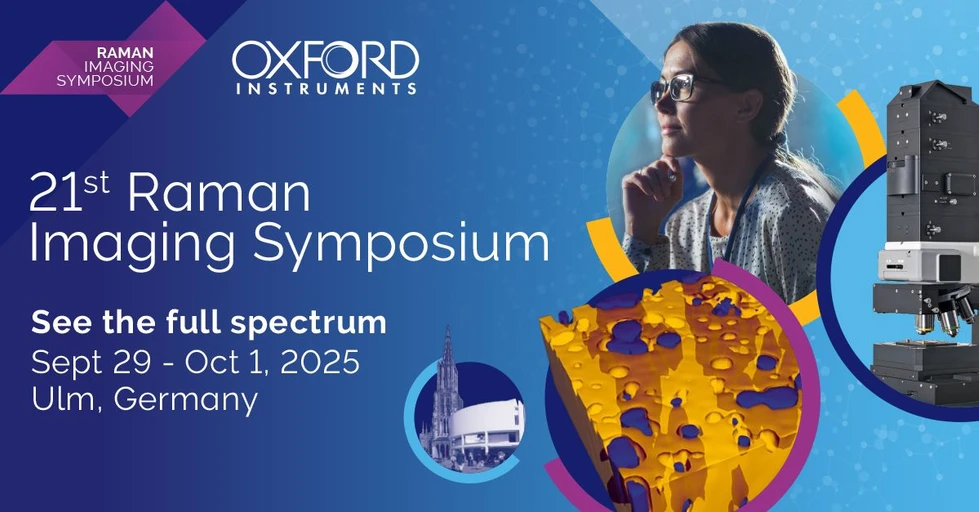
The 21st Raman Imaging Symposium will take place September 29 to October 1st, 2025 in Ulm, Germany. This annual event brings together the international Raman imaging community to explore the latest technical developments and their applications across a wide range of research fields.
Esteemed speakers from academia and industry will share their expertise on topics spanning material sciences, electronics, and energy storage, including emerging trends in material and polymer engineering, 2D materials, electrochemistry, and microelectronics. The program will also highlight advancements in geosciences, specifically in mineralogy, and life sciences, with an emphasis on cellular and tissue biology.
The symposium provides a dynamic platform for knowledge exchange, networking, and collaboration. Poster sessions and contributed talks invite participants to present their own research in an engaging and interactive environment. On the third day, attendees will have the opportunity to experience hands-on equipment demonstrations at the Oxford Instruments Ulm site and engage directly with the company’s experts in development and applications.
Join us this September to connect with fellow researchers, gain fresh perspectives, and discover the innovations shaping the future of Raman imaging and spectroscopy. Researchers from all disciplines are cordially invited.
Important Dates
- July 21st: Early Bird Registration Deadline
- August 15th: Abstract Submission Deadline
- September 16th: Participant Registration Deadline
- September 29th: Start of the Raman Imaging Symposium
- September 30th, 7 pm: Conference Dinner
- October 1st: Equipment Demonstrations
Registration
Register HERE
Registration fees
- Industrial ticket: €560
- Academic ticket: €445
Abstract Submission
To submit your abstract, please send it directly to [email protected].
Please Note: Presenting authors must first register as a participant at the Symposium before submitting an abstract.
To register for the Symposium, please get your ticket here.August 15th - Abstract Submission Deadline
In addition to invited lectures, the scientific program will include contributed talks and a poster sessions. The selection of contributed talks and posters will be based on the submitted abstracts.
Please prepare your abstract using the template linked below and send your Abstract to the email address below.
Be sure to include in the email subject line: your session preference and your requested contribution type (talk or poster). Feel free to email us with any questions.
Please note:
- August 15th - Abstract Submission Deadline
- Presenting authors must register for the conference.
- Please let us know your preference (talk or poster)
- Accepted abstracts (talks and posters) will be posted on the Symposium website and printed in the Symposium Abstract Book.
- Due to space constraints, the number of participants will be limited.
- Submitted abstracts can only be evaluated after successful registration.
- The registration must be completed in advance.
Program
Speakers
Sebastian Schlücker (University of Duisburg-Essen, Germany)
- As Professor of Physical Chemistry at the University of Duisburg-Essen (Germany), his research interests include the design, synthesis and bioanalytical applications of SERS nanoparticle probes as well as the development and application of laser spectroscopic techniques in biophysical chemistry.
Thomas Dieing (WITec GmbH, Ulm, Germany)
- Dr. Thomas Dieing is the head of R&D in the Ulm site of Oxford Instruments. He obtained his PhD from La Trobe University, Melbourne, Australia in 2005 investigating the MBE growth of nitrogen containing III/V semiconductors. In 2006 he joined WITec’s application team and became Director of Applications and Support. Following an extensive period as the product manager for WITec’s alpha300 product line and its accessories, he took over as head of R&D start of 2025 and is now responsible for all product development of the WITec product lines.
Linsen Li (Shanghai Jiao Tong University, China)
- Prof. Linsen Li is a tenured associate professor of Chemical Engineering at Shanghai Jiao Tong University. He obtained his Ph.D. in Materials Chemistry from University of Wisconsin-Madison in 2015 and worked as a postdoc at Massachusetts Institute of Technology in 2015–2017. His research efforts are focused on materials chemistry and multimodal characterization techniques for battery materials and pharmaceuticals.
Edith Perret (Empa Swiss Federal Laboratories for Materials Science and Technology, St. Gallen, Switzerland)
- Dr. Edith Perret works as a scientist at Empa in St. Gallen, Switzerland since 2018. Her research focuses on developing novel functional polymeric fibers for technical and medical applications. She will be the ad interim group leader of the Polymer Processing Group at Empa St. Gallen, starting January 1, 2026. She studied materials science at ETH Zurich (2001-2006) and did her doctoral studies in physics at the Paul Scherrer institute (2006-2010), Switzerland.
Keith Gordon (University of Otago, Dunedin, New Zealand)
- Prof. Keith Gordon received his BSc Hons (I) in 1986 and PhD in 1989 in chemistry from Queens University, Belfast, UK. He was a Director’s Fellow at Los Alamos National Laboratories, USA, from 1989 – 1992. In 1993 he took up a lecturing post in the Chemistry Department at the University of Otago, Dunedin, New Zealand, becoming Professor in 2009. His research interests focus on the understanding the properties of conducting polymers, nanostructured electromaterials, such as found in dye-sensitised solar cells, dairy products and pharmaceuticals using spectroscopy and computational chemistry.
Nathalie Jung (Université de Fribourg, Fribourg, Switzerland)
- Nathalie Jung is a Postdoctoral Researcher at the Adolphe Merkle Institute in Fribourg, Switzerland. She combines her background in human biology, pharmaceutical sciences, and Raman microscopy to investigate molecular changes in human cells and tissue models in the context of disease, nanotoxicology, and material-cell interactions.
Jean-Francois Bardeau (Centre national de la recherche scientifique, CNRS, France)
- Prof. Jean-François Bardeau is Director of Research at CNRS and since March 2024, Director of the ICMN laboratory (UMR 7374, University of Orléans – CNRS). His research focuses on structural and dynamic properties of hybrid materials, biomaterials, and functional surfaces, with a recent emphasis on electromagnetic enhancement phenomena on multinanostructured metallic surfaces for SERS sensor development. Author of over 150 publications and 5 patents, he is also a member of the French Group of Vibrational Spectroscopies (GFSV) and has received several distinctions for his contributions.
Fabrizio Nestola (University of Padua, Italy)
- Fabrizio Nestola is Full Professor in Mineralogy at the Department of Geosciences, University of Padova, Italy, and his research activity is mainly focused on the investigation of mineral inclusions in natural diamonds, meteorites and discovery of new mineral species mainly by micro-Raman spectroscopy, single-crystal X-ray and electron diffraction and scanning electron microscopy.
Sebastian Speer (Forschungszentrum Jülich GmbH, Jülich, Germany)
- Postdoc at the Institute of Energy Technologies: Fundamental Electrochemistry (IET-1) at Forschungszentrum Jülich. My research focusses on ex situ and in operando Raman analysis of materials used in proton exchange membrane water electrolysis.
Barbara Kosednar-Legenstein (Materials Center Leoben Forschung GmbH (MCL), Leoben, Austria)
- Barbara Kosednar-Legenstein is laboratory manager in the Department Microelectronics at the Materials Center Leoben (MCL). Among of a variety of analyses of various material applied in the field of microelectronics she uses Raman microscopy to solve questions which cannot be answered by other techniques.
Wolfgang Kiefer (University of Würzburg, Würzburg, Germany)
- Dr. Kiefer is Prof. Emeritus of the Physical Chemistry Institute at the University of Würzburg, Germany. He is also Honorary Professor (Prof. h.c.) of the Universities of Beijing and Wuhan (both China) as well as Honorary Doctor (Dr. h.c.) of the University of Cluj-Napoca, Romania.
Yuling Wang (Macquarie University, Sydney, Australia)
- Prof Yuling Wang is an Australian Research Council (ARC) Future Fellow at Macquarie University, Australia. She completed her PhD at Chinese Academy of Sciences in 2009. She was then awarded Alexander von Humboldt (AvH) Fellowship (2010-2012), German Research Foundation (DFG) individual grant (2012-2014), ARC Discovery Early Career Researcher Award (DECRA, 2014-2017) and Future Fellowship (2022-2026). Her research focuses on platform technology that utilizes rationally designed plasmonic nanomaterials and surface-enhanced Raman scattering (SERS) for biomarkers sensing, aiming to enhance in vitro diagnostics and personalized medicine.
Program Schedule
🗓️Monday, September 29, 2025
14:00 – 14:30 Registration
14:30 – 14:45 Welcome
14:45 – 15:45 The principles of Raman spectroscopy and its application in microscopy
- Sebastian Schlücker (University of Duisburg-Essen, Germany)
15:45 – 16:00 Coffee
16:00 – 16:45 3D confocal Raman imaging: instrumentation, performance and correlative techniques
- Thomas Dieing (Oxford Instruments WITec, Ulm, Germany)
16:45 – 17:30 Coupling Raman microscopy and chemometrics in the study of complex materials
- Keith Gordon (University of Otago, Dunedin, New Zealand)
17:30 – 19:15 Poster session & Get-together with snacks and beverages
19:15 – 19:45 Evening Lecture: Observation of Raman-Shifted Fraunhofer Lines
- Wolfgang Kiefer
- Sebastian Schlücker
🗓️Tuesday, September 30, 2025
08:45 – 09:00 Coffee
Session I – Insights to Biomaterials, Life Sciences and Pharmaceutical Research
09:00 – 09:30 Tracking cellular stress across scales: from tissue to single cells
- Nathalie Jung (Université de Fribourg, Fribourg, Switzerland)
09:30 – 10:00 Correlative SEM-Raman Studies of Functional Materials: A Magic Journey from Batteries to Pharmaceuticals
- Linsen Li (Shanghai Jiao Tong University, China)
10:00 – 10:30 Applications of SERS in Biosensing and Bioimaging
- Yuling Wang (Macquarie University, Sydney, Australia)
10:30 – 11:00 Coffee
Session II – Diamond in Geological and Industrial Processes
11:00 – 11:30 Micro-Raman spectroscopy and natural diamonds: a journey to the deep Earth
- Fabrizio Nestola (University of Padua, Italy)
11:30 – 12:00 t.b.c.
- N.N.
12:00 – 13:00 Lunch & Poster session (continued)
Session III – Exploring Novel Materials
13:00 – 13:30 High-resolution Raman imaging of polymer fibers
- Edith Perret (Empa Swiss Federal Laboratories for Materials Science and Technology, St. Gallen, Switzerland)
13:30 – 14:00 Watching oxygen evolve: Shedding light on PEM anodes with tailored Raman spectroscopic methods
- Sebastian Speer (Forschungszentrum Jülich GmbH, Jülich, Germany)
14:00 – 14:30 Raman microscopy in the field of microelectronics materials
- Barbara Kosednar-Legenstein (Materials Center Leoben Forschung GmbH, Leoben, Austria)
14:30 – 15:00 Coffee
15:00 – 15:30 Exalting the Invisible: High-Sensitivity Raman Imaging and Spectral Data Analysis for Micrometric Insights
- Jean-Francois Bardeau (Centre national de la recherche scientifique, CNRS, France)
15:30 – 16:00 t.b.a.
- N.N.
16:00 – 16:15 Coffee
16:15 – 17:30 Session IV – Contributed Presentations
Starting 19:00 Conference dinner & Poster Award ceremony
🗓️Wednesday, October 1, 2025
09:00 – 09:15 Welcome
09:15 – 10:00 Equipment demonstration: Confocal Raman imaging microscopy – The WITec Raman Microscope Series
10:00 – 10:15 Coffee
10:15 – 11:00 Software demonstration: WITec Software Suite
11:00 – 11:30 WITec house tour – Guided tour through WITec headquarters
11:30 – 13:00 Lunch
13:00 – 16:00 Equipment demonstrations
- Raman Imaging
- TrueSurface – Topographic Raman imaging
- alphaCART – Mobile Raman microspectroscopy
- Particle Analysis
- RISE – Correlative Raman-SEM
16:00 Wrap-up & Coffee
Location and Travel
The first two days of the Symposium take place in the Stadthaus, right next to the famous Ulm Minster in the city center. The address is: Münsterplatz 50, 89073, Ulm, Germany. For the third day, the Symposium moves to WITec headquarters, Lise-Meitner-Str. 6, 89081 Ulm, Germany, for equipment demonstrations and individual discussions.