8th Brazilian Meeting on Chemical Speciation & 17th Rio Symposium on Atomic Spectrometry
Dear Colleagues and friends,
We are excited to announce the 8th Brazilian Meeting on Chemical Speciation (8th EspeQBrasil) and the 17th Rio Symposium on Atomic Spectrometry (17th RSAS), which will be held jointly at the beautiful Hotel Fazenda Fonte Colina Verde in São Pedro City, São Paulo State, Brazil. This event will bring together researchers, professionals, and experts from diverse fields to share the latest advancements and innovations in chemical speciation and atomic spectrometry.
We are thrilled to provide a platform for fruitful discussions, knowledge exchange, and networking opportunities. During the event days, attendees will have the chance to engage in inspiring sessions, collaborate on new ideas, and explore solutions to some of the most pressing scientific challenges.
We look forward to welcoming you to this exciting event and hope you make the most of this enriching experience!
Topics of 17th RSAS:
1. Atomic and fluorescence spectrometry
Applied studies that employ or develop methods using techniques based on atomic absorption/emission spectrometry and fluorescence studies as tools for quantitative analysis in various samples, as well as advancements in these techniques, such as real-time process monitoring. Additionally, studies focused on sample preparation for these techniques.
2. Plasma-based techniques
Development and application of analytical techniques based on plasma. Additionally, studies focused on sample preparation for these techniques.
3. Techniques based on X-ray, Raman, and Mössbauer
Studies involving the development of methods using X-ray absorption, emission, scattering, and diffraction techniques. Research applying X-ray-based techniques in areas such as environmental sciences, materials science, life sciences, nanotechnology, and related fields. Studies focused on the use of Raman spectroscopy for the quantification of various samples, including analyses using Raman in its original form as well as variations such as confocal Raman and SERS. Additionally, research directed toward advancements in these techniques and sample preparation for their application.
4. Synchrotron-radiation based techniques
Studies across all scientific fields that utilize synchrotron light-based techniques. The topic encompasses both methodological and applied research. Additionally, studies focused on sample preparation for these techniques.
5. Techniques based on SIMS and nanoSIMS
Development of methods and applications of techniques based on secondary ion mass spectrometry in interdisciplinary areas. Studies involving sample preparation and applictions for various matrices.
6. Hyphenated/multimodal techniques
Development and advancements of hyphenated and multimodal techniques for research in interdisciplinary areas. Additionally, studies focused on sample preparation for these techniques.
7. Chemometrics in spectrometry
Studies involving the use of chemometric tools for the development, validation, and classification of methods derived from spectrometric analyses.
8. Trends and new approaches
Novel and innovative applications in the development and use of spectrometric techniques for the analysis of various materials, such as chemical, biological, pharmaceutical, environmental, geological, industrial, and others. Additionally, studies focused on sample preparation for these techniques.
Topics of 8th EspeQBrasil:
1. Speciation and Fractionation in the Environment
Studies on chemical speciation, fractionation, and bioavailability of elements in water, soils, and sediments, assessment of ecological risks and contaminant mobility in natural environments. Research on speciation and chemical fractionation applied to biogeochemical processes.
2. Speciation and Fractionation Analysis in Life and Pharmaceutical Sciences
Studies on chemical speciation and fractionation in biological systems, metal-protein interactions, chemical speciation in diseases, and the impact of speciation on bioavailability and toxicity. Research on chemical speciation and fractionation in pharmaceuticals. Speciomics.
3. Speciation and Fractionation in Nutrition and Food Sciences
Studies on chemical speciation and fractionation in food and their bioavailability, the impact of chemical speciation and fractionation on human and animal nutrition, including the toxicity and benefits of specific mineral forms.
4. Speciation and Fractionation in Industrial and Mining Processes
Studies on speciation, chemical fractionation, and element mobility in industrial processes, mining, water treatment, and energy production. Waste management, recycling of critical metals, and controlling contaminant emissions.
5. Advances in Analytical Techniques and Sample Preparation for Chemical Speciation and Fractionation
Development of methods and application of analytical techniques (e.g., ICP-MS, HPLC-ICP-MS, XAS, and DGT) for fractionation and speciation analysis. Analytical methodologies for sample preparation and analysis in chemical speciation and fractionation across various sample types.
6. Emerging Topics in Chemical Speciation and Isotope Analysis
Chemical speciation and fractionation of nanomaterials, microplastics, and emerging contaminants. Monitoring and risk assessment of new organic and inorganic species and their chemical interactions with biotic or abiotic factors. The impact of climate change on the biogeochemical cycles of elements and chemical speciation. Speciation and fractionation under extreme experimental or environmental conditions, such as polar regions, volcanic zones, or deep marine environments. Applications of speciation in renewable energies. Innovative isotopic techniques, in situ and real-time speciation. Speciation in molecular modeling and bioinformatics.
Chemical speciation using synchrotron radiation. Synthesis and application of organometallic species.
Registration
We kindly ask you to complete your registration according to the event of your choice:
- For registration for the 8th Brazilian Meeting on Chemical Speciation AND the 17th Rio Symposium on Atomic Spectrometry, please CLICK HERE
- For registration for the 8th Brazilian Meeting on Chemical Speciation ONLY, please CLICK HERE
- For registration for the 17th Rio Symposium on Atomic Spectrometry ONLY, please CLICK HERE
Registration fees
8th Brazilian Meeting on Chemical Speciation and the 17th Rio Symposium on Atomic Spectrometry
SBQ* affiliate member
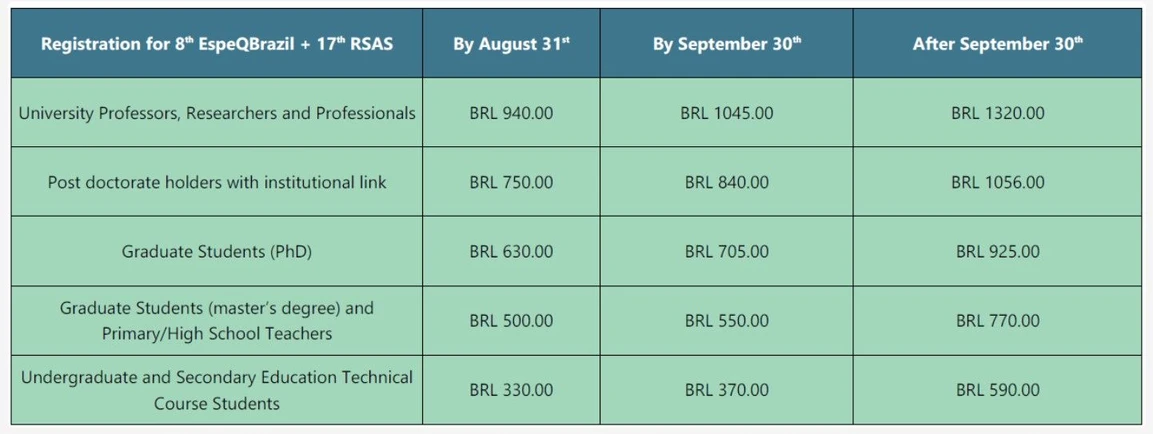 8th EspeQBrasil & 17th RSAS: SBQ* affiliate member
NON-SBQ* affiliate member
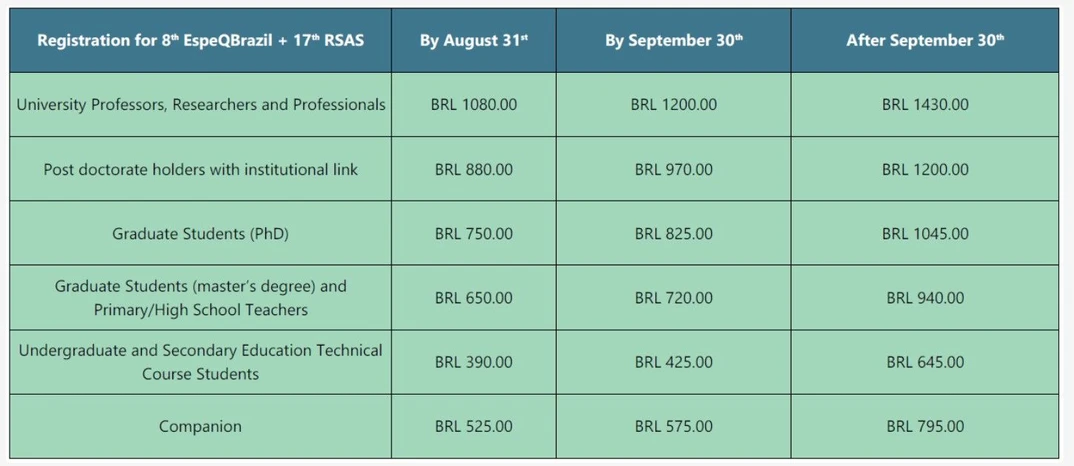 8th EspeQBrasil & 17th RSAS: NON-SBQ* affiliate member
17th Rio Symposium on Atomic Spectrometry
SBQ* affiliate member
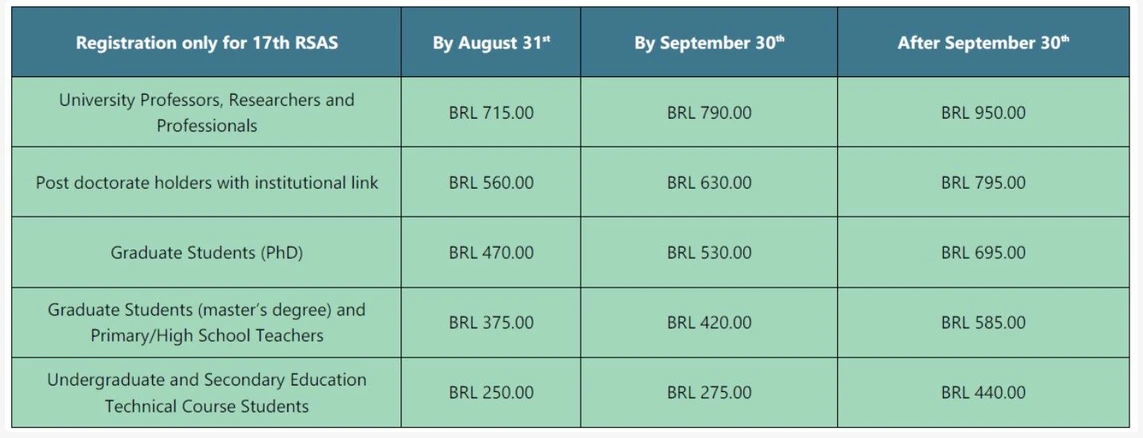 17th Rio Symposium on Atomic Spectrometry: SBQ* affiliate member
NON-SBQ* affiliate member
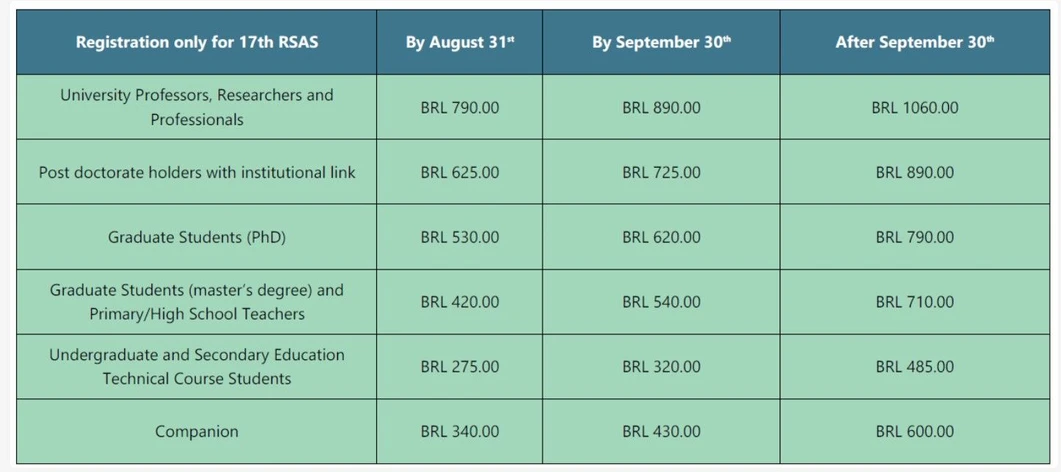 17th Rio Symposium on Atomic Spectrometry: NON-SBQ* affiliate member
8th Brazilian Meeting on Chemical Speciation
SBQ* affiliate member
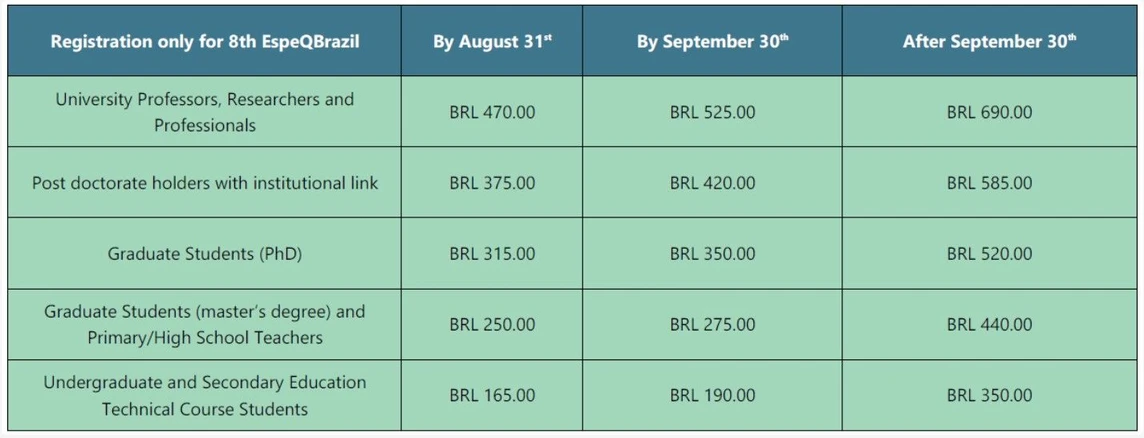 8th Brazilian Meeting on Chemical Speciation: SBQ* affiliate member
NON-SBQ* affiliate member
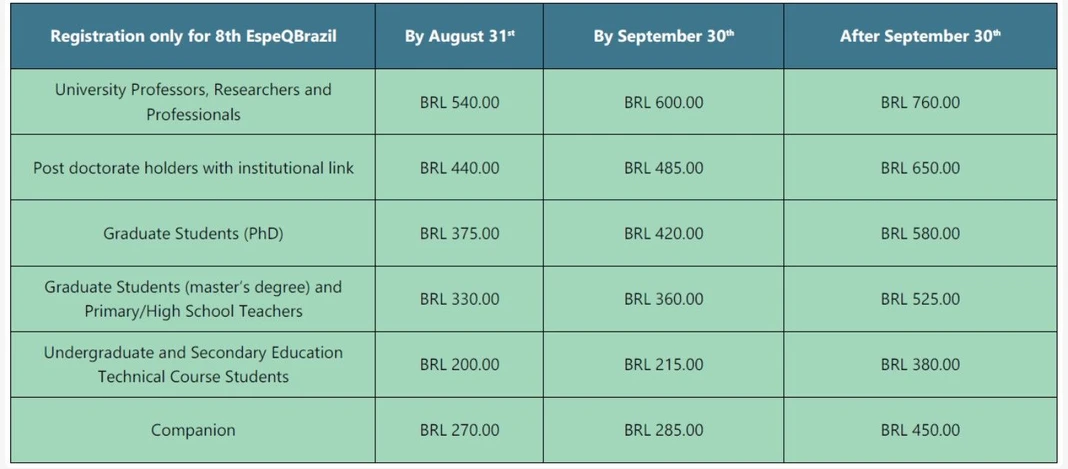 8th Brazilian Meeting on Chemical Speciation: NON-SBQ* affiliate member
Abstract submission
- To submit to the 8th Brazilian Meeting on Chemical Speciation, click HERE
- To submit to the 17th Rio Symposium on Atomic Spectrometry, click HERE
Program
Short course RSAS 2025
- Analytical Method Validation - Thiago de Oliveira Araujo
- Forensics applied to spectrometry - Clesia Cristina Nascentes and Marcia Andreia Mesquita Silva da Veiga
- Spectrometry devoted to solid sampling - Ciro Eliseo Márquez Herrera and Edenir Rodrigues Pereira Filho
Short course EspeQBrasil 2025
- How can elemental-specific detection help with non-target analysis for emerging contaminants? - Jörg Feldmann and Viktoria Mueller
- Sample preparation for chemical speciation/fractionation – Ana Rita A. Nogueira and Fábio Andrei Duarte
Venue
Hotel Fonte Colina Verde – São Pedro
- SP Address: Rua Veríssimo Prado, 1500
- Phone: +55 (19) 3481 9999
- Whatsapp: +55 (19) 982380380
- Address: Rua Veríssimo Prado, 1500, São Pedro – SP – Brasil
- Email – [email protected]
- Website – https://www.hotelcolinaverde.com.br/
SPONSORS AND SUPPORT
 8th EspeQBrasil & 17th RSAS: Sponsors