SciX 2025
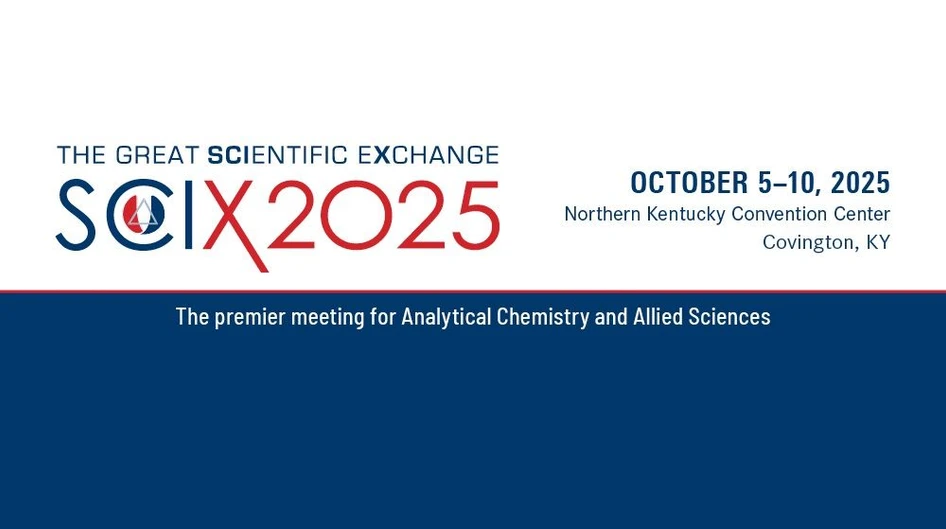
The Federation of Analytical Chemistry and Spectroscopy Societies (FACSS) has organized an international conference at the forefront of analytical chemistry and allied sciences since 1974. In 2011, this conference was renamed to the SciX Conference presented by FACSS with the tagline "The Great Scientific Exchange." The SciX conference continues to grow because it is highly valued by attendees for its technical program, world-class exhibits, and many career-building networking opportunities.
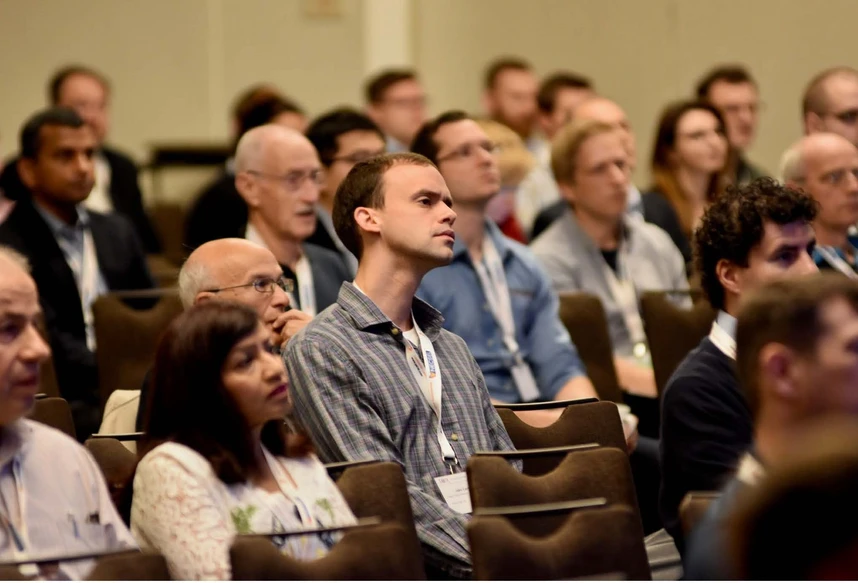 SCIX: Oral sessions
Why attend SCIX?
- Experience something new, connect with scientists worldwide, and enjoy yourself while sharing your expertise. At SciX, your participation truly shapes the community.
- Our approach to scientific exchange is both unique and inclusive, highly valued by all who attend.
- SciX seamlessly blends a vibrant technical program, engaging short courses, innovative vendor showcases, and valuable networking opportunities for career development.
- One key to SciX's ongoing success is its ability to evolve year after year, introducing fresh ideas and concepts to the community. Many of these innovations stem directly from attendees, whose contributed abstracts form a significant portion of the technical program.
- SciX is committed to providing an enriching experience that contributes to attendees' professional growth, ensuring they leave the conference equipped with new knowledge and insights to apply in their laboratories or companies.
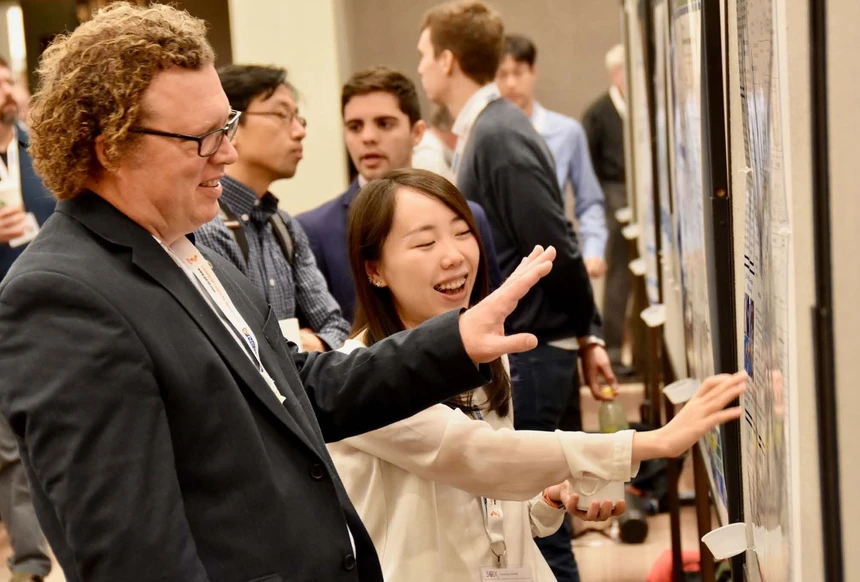 SciX: Poster session
Key Dates & Deadlines
- Abstracts Open: April 1, 2025
- Oral Abstract Deadline: May 16, 2025
- Poster Deadline: June 30, 2025
- Early Bird Registration Deadline: August 15, 2025
- Hotel Booking Deadline: September 12, 2025
- Preconference Registration: October 4, 2025
- Onsite Registration: October 5, 2025
Registration
Registration fees
EARLY BIRD (Opening - August 15)
- Member: $780
- Non-Member: $855
- Student: $275
- Undergraduate and Graduate only; post doc not eligible.
- Retiree: $305
- One Day: Available onsite only
REGULAR (August 16- October 4)
- Member: $830
- Non-Member: $905
- Student: $275
- Undergraduate and Graduate only; post doc not eligible.
- Retiree: $330
- One Day: Available onsite only
ONSITE (October 5-10)
- Member: $880
- Non-Member: $955
- Student: $350
- Undergraduate and Graduate only; post doc not eligible.
- Retiree: $355
- One Day: $495
Registration includes:
- Access to all scientific sessions and the exhibit hall
- Daily morning and afternoon coffee breaks
- Boxed lunch in the exhibit hall Tuesday and Wednesday
- Social events and refreshments daily
- Special gala event on Thursday evening including food and a drink ticket
You may purchase a companion registration for a spouse or guest. This rate is $125 per person. The companion registration includes the Sunday night mixer, Monday exhibit hall reception, Tuesday evening Exhibitor Happy Hour, and Thursday Gala. Please note guests need to be 18 or over to attend the Gala. The companion must be with the attendee at all times. You can add your guest as an attendee when registering on the website.
Please note: Early Career is described as a terminal degree granted after 2022 (3 years). The Early Career registration type is a single discount applied to registration and short courses limited to the first 50 early career attendees.
SHORT COURSES
Choose to attend one or more Short Courses taking place throughout the SciX conference. These courses are open to conference and non-conference attendees for a separate registration fee (noted below). Onsite registration is not guaranteed.
Technical Short Courses
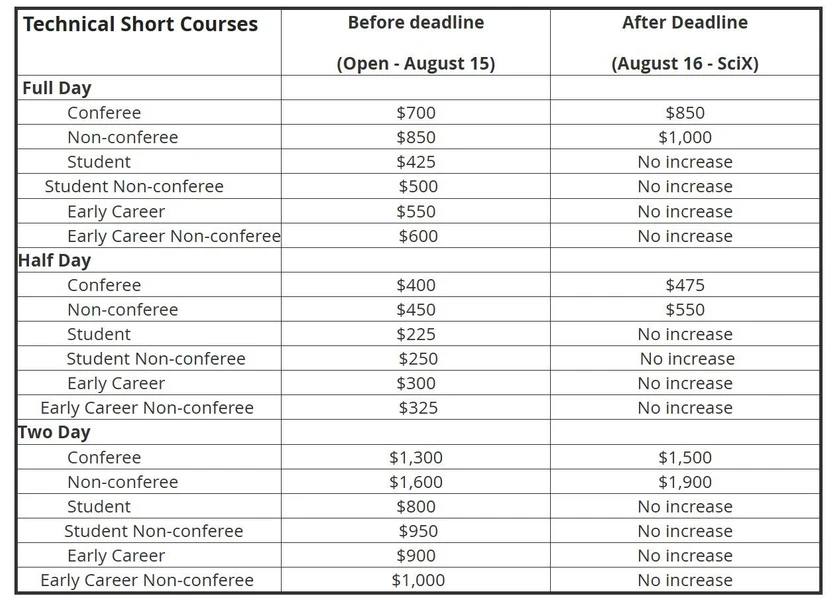 SCiX 2025: Technical Short Courses
Professional Development Short Courses
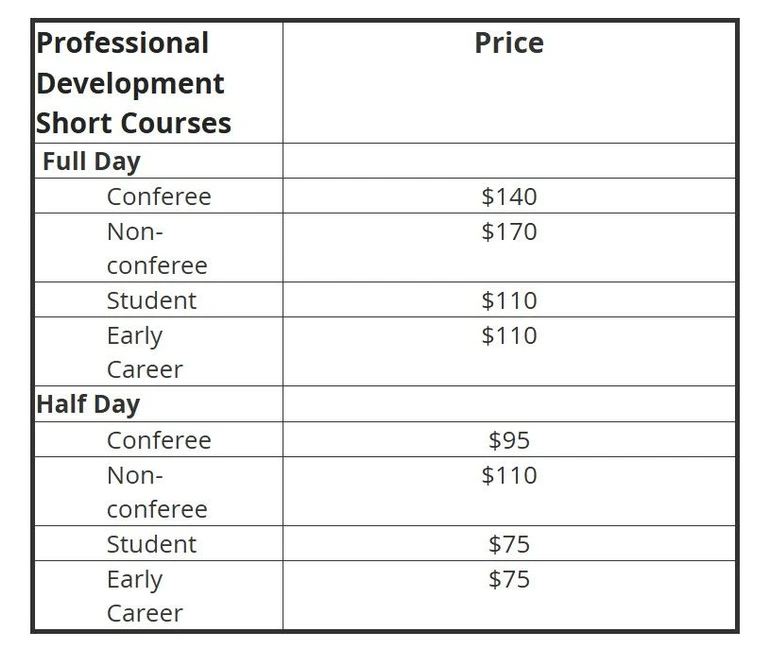 SCiX 2025: Professional Development Short Courses
Abstract submission
Poster abstract deadline on June 30, 2025 at 11:59pm EDT.
General Submission Guidelines
Before You Begin, Do You Have this Information?
Read all instructions below before beginning and be sure you have:
- For each author: title, first and last names, organizational affiliation, position, and e-mail address
- For the presenting author: career level (student, post-doc, early career, professor, professional, retired)
Submission Types
- Oral Submissions: These will be reviewed for acceptance by session chairs. Submitters will be notified of acceptance around mid-summer. Abstracts not assigned to an oral session will be given the opportunity to present as a poster.
- Poster Submissions: These will be reviewed for acceptance, and notification sent when the review is complete. Specific poster session assignments will be provided to those accepted by Mid-August.
- Oral or Poster Submissions: Submissions that would like to be considered for either an oral or poster will be reviewed for oral presentations first. If not assigned to an oral session, the submitter will be notified which poster session it has been assigned to.
Submission Deadlines:
- Oral Submissions: May 16, 2025 at 11:59pm EDT
- Poster Submissions: June 30, 2025 at 11:59pm EDT
Abstract Style
- Your abstract will be published exactly as you submit it. Check submissions carefully for typographical errors, author listing, misspellings, poor hyphenation, etc.
- Each submission will be asked for fifteen words or less to explain the significance of the contribution. This sentence will be included in the abstract as the “Novel Aspect”.
- You will be asked to choose a primary section that are the best fit for your submission (your abstract may ultimately be assigned to a section that you did not choose). You will then be able to choose up to three topics. These choices will help chairs select abstracts for oral symposia.
- The maximum number of words allowed for each submission is 350.
Authors and Author List
Please check off the 'presenter' button for the presenting author.
Author Order:
Use arrow keys to change the order of the authors, as needed. Follow these rules:
- List the Presenting Author first
- If the Advisor or Project Lead is not the Presenting Author, list that person last
Proper Author Profile Details:
Keep affiliation names consistent as the system does not detect authors from the same organization if different organization names are used. The default convention should be the full name of the organization; e.g. use University of California, Los Angeles, not UCLA. Omit leading articles (for example, do not use The University of California, Los Angeles).
Receipt Confirmation
If you do not receive an email confirmation within one business day, check your junk/spam folder first, then email [email protected] with your Paper Submission ID number and title.
IT IS YOUR RESPONSIBILITY TO VERIFY A CONFIRMATION EMAIL IS RECEIVED. IMPORTANT MEETING COMMUNICATION WILL BE SENT TO THIS ADDRESS FROM THE SYSTEM LEADING UP TO SCIX.
Presenter Guidelines
Oral Speaker Guidelines
You should plan for your presentation to last 20 minutes, including 2-3 minutes for questions.
- Aspect Ratio for all talks is 16:9.
- Prepare your slides and transfer onto your own USB stick.
Giving Your Talk On-site
- There is no speaker ready room on-site.
- Arrive at your session room 30 minutes prior to the start of your session.
- Speakers will not present from their own laptop but instead pre-load their presentation onto the room PC laptop.
- Connect your USB stick to the session room laptop (PC running Windows 10 and MS Office 2016 with PowerPoint).
- Please save your presentation to the desktop.
- No sellable items are to be displayed in session rooms.
ON-SITE POSTER GUIDELINES
Please set your poster up at 9:15am sharp on the day of your poster session. Please plan to present your poster on the day of your poster session during the designated poster session from 9:30am to 10:30am and 3:10pm to 3:50pm. Posters will remain in place all day, but you are required to be present only twice during the two poster sessions.
POSTER BOARDS/POSTER SIZE: Each author will be provided one board with a presentation area measuring 4 feet tall x 8 feet wide. You do not have to create a poster to fill the entire board. We recommend you choose a landscape orientation. Each board will be numbered. Push pins will be provided.
- TITLE: The title should span at least 2/3 of the width of your poster. Lettering should be at least 3/4" to 1" high (72 pt. bold). The banner should include the author(s) and affiliation(s).
- CONTENT AND LAYOUT: Use a sans serif font such as Arial or Helvetica in a minimum size of 24 pt. (1/4" high). Text, figures and photographs should be readable from a distance of 4 feet. If using multiple panels, number them in the order they should be viewed and arrange them in a logical flow from top left to lower right.
- HANDOUTS: Authors are welcome to provide handouts, e.g., preprints, extended abstracts, copies of poster panels, etc. No saleable items may be displayed. Handouts are not required, but do help attendees who may have missed the in-person presentation to have the materials and possibly make contact with the author for follow-up requests
POSTER NUMBERS:
- Your poster number is based on the day you are to present. Each number has either a Mon, Tu, Wed or Thur before it- this is to indicate the day.
- The boards will NOT have Mon, Tu, Wed or Thur on them so only match the number you are given.
Program
Short Courses
Prepare yourself for an exceptional array of short courses at SciX 2025! We are excited to announce that our short courses are undergoing a transformation and will soon feature refreshed, cutting-edge content designed to enrich your conference experience. Stay tuned for the final short course schedule!
Whether you intend to supplement your conference registration or exclusively partake in our short courses, anticipate an opportunity to enhance your expertise and capabilities. Head to the registration page to register for short courses! The short course rate will increase on September 9 to the regular rate. Take advantage of early bird rates now!
Course descriptions & instructors
Sunday, october 5
CSAS 109: Practical Guide to Atomic Absorption and Emission Spectroscopy
- Presented by: Dula Amarasiriwardena | ½ day
This course will cover recent advances in analytical atomic spectroscopy, including flame atomic absorption spectroscopy (FAAS), inductively coupled plasma-optical emission spectroscopy (ICP-OES), hydride generation (HG)-AAS, cold vapor(CV)-AAS, and graphite furnace AAS (GF-AAS). Course content includes fundamentals, theory, instrumentation, practice, troubleshooting hints, and common applications. We will also briefly discuss sample preparation methods available for spectrochemical analysis. Analytical merits and limitations of each method will be presented
Csas 101: Introduction to Infrared, Raman, and near infrared spectroscopy
- Presented by: James de Haseth | ½ day
This course will present the origins of spectral bands in Infrared, Raman, and NIR spectra. This will start with a discussion of fundamental molecular vibrations and where these are present in mid-infrared and Raman spectra and explain how overtone and combination bands can appear in the NIR as well as in mid-infrared and Raman spectra. Some direct guidelines will be presented to show which transitions are allowed. This will not be a theoretical discussion that involves mathematics or quantum mechanics, but rather an understanding of the physical phenomena that led to the development of the mathematical approaches. A key issue to the collection of good spectra is an understanding how spectrometers work. Such topics include instrument components, resolution, spectral range, measurement sensitivity, instrumental effects on spectral lineshape, instrument sources of errors, and effects of mathematical manipulation of spectra.
CSAS 113: Spectral interpretation of vibrational spectra
- Presented by: Peter Larkin & Mary Carrabba | 2 days
Infrared and Raman spectroscopy, NMR and Mass spectroscopy are essential techniques to elucidate chemical structure. The success and popularity of NMR and mass spectroscopy have resulted in a general loss of institutional knowledge among most users of IR and Raman interpretation skills. The ability to understand and identify functional groups by interpreting IR and Raman spectra is essential for successful use by end users of these vibrational spectroscopy techniques.
This two-day course provides an introduction to IR and Raman spectra. The course content focuses on developing a fundamental understanding of group frequencies and how to apply this to determine molecular structure using both the IR and Raman spectra. Lectures are supplemented with multiple well illustrated examples as well as in-class spectral problem sets under the guidance of highly experienced industrial spectroscopists.
Monday, october 6
CSAS 104: How to select, configure, and optimize Raman spectrometer for your application: from theory to practice
- Presented by: Alexander Rzhevskii | 1 day
The purpose of this course is to familiarize a wide circle of experimenters with the fundamentals and applications of modern Raman spectroscopic techniques with the focus to confocal Raman microscopy and imaging. The basics of Raman spectroscopy, instrumentation, principles of operation, and the main characteristics of Raman spectrometers and microscopes will be presented in the course. Examples of the application of Raman microscopy for the characterization of spatial structure, composition, and properties of “real world” samples and objects with the emphasis on nanomaterial, polymer, pharmaceutical, cellular, microorganism, plant, and food product studies will be provided
CSAS 113: Spectral interpretation of vibrational spectra
- Presented by: Peter Larkin & Mary Carrabba | 2 days
Infrared and Raman spectroscopy, NMR and Mass spectroscopy are essential techniques to elucidate chemical structure. The success and popularity of NMR and mass spectroscopy have resulted in a general loss of institutional knowledge among most users of IR and Raman interpretation skills. The ability to understand and identify functional groups by interpreting IR and Raman spectra is essential for successful use by end users of these vibrational spectroscopy techniques.
This two-day course provides an introduction to IR and Raman spectra. The course content focuses on developing a fundamental understanding of group frequencies and how to apply this to determine molecular structure using both the IR and Raman spectra. Lectures are supplemented with multiple well illustrated examples as well as in-class spectral problem sets under the guidance of highly experienced industrial spectroscopists.
CSAS 102: Spectral Searching
- Presented by: James de Haseth | ½ day
In a general sense, spectral searching is a simple operation. An unknown spectrum is presented to the search system software, the spectral databases are searched, and a result presented. This simple operation in no way explains how to optimize the process to arrive at the best, ideally the correct, identification. There is more than one search algorithm, so which one should be used? What if the unknown compound is not in the database? What if the unknown spectrum represents a mixture? How can we proceed to find these answers? This course will address these issues and more. Participants will be provided with a two-week trial copy of Wiley KnowItAll® Software to use during and after the course. It will not be possible to provide laptop computers for participants; therefore, the software will be made available to the participants shortly before the course so that it can be installed on a Microsoft Windows 10, or later, laptop computer.
CSAS 103: Collecting Infrared Spectra and Avoiding Pitfalls
- Presented by: Ellen Miseo & Jeff D'agostino | 1 day
Users of FT-IR spectrometers may have received little or no formal training in spectroscopy and therefore cannot distinguish between “good” and “bad” spectra. In this course, we will show many of the problems that are commonly encountered with FT-IR spectra measured by inexperienced (and often experienced!) users and show how to avoid them.
Tuesday, october 7
CSAS 118: Technologies and applications for miniature optical spectrometers and spectroscopic sensors
- Presented by: Richard Crocombe | ½ day
In the past twenty years optical spectrometers have shrunk dramatically in size, giving us successively laboratory-portable, toaster-sized, instruments; cordless-drill-sized portable instruments for use in the field; and onto spectrometers the size of a computer mouse or deck of cards. The latest development in portable spectroscopy is the availability of very low-cost multispectral sensors, the size of computer chips, leading to the possibility of embedding them into consumer goods.
Multispectral sensors can now not only be incorporated into ‘white goods’ like washing machines and dryers, but also into ‘fitness’ products like smart watches and sports watches, and as photonic miniaturization increases, into ‘wearables’ like smart rings, providing the user with health information. A variety of photonic components and technologies can be utilized for these miniature devices including silicon photonics and photonic integrated circuits (PICs), produced en masse using semiconductor manufacturing techniques; components from LiDAR including SPAD arrays; electronically-tunable detectors; and ‘photonic’, ‘plasmonic’ and ‘computational’ devices. This course surveys technologies and applications for miniature optical spectrometers and spectroscopic sensors.
SciX 136: Sample Selection Design of Experiments (DOE) for Multivariate Calibration
- Presented by: Art Hamfeldt & Michael Roberto | ½ day
This course will cover the use of Design of Experiments (DOE) for sample selection for the development of multivariate calibration models. Matrixes are becoming more challenging as the desire to deploy spectroscopy has increased. Those new to building multivariate calibration models have a tendency to build oversampled models with samples that are completely overlapping between instruments, probes, and/or matrix solutions. The DOE approach discussed in this course can help identify the minimum number of samples required, thus resulting in saving time and resources while building more robust models.
CSAS 117: Laser Fundamentals for Spectroscopy
- Presented by: Rob Chimenti | ½ day
- This course is designed to give attendees an introduction to the fundamentals of laser physics as well as a practical understanding of common laser designs and their applications in spectroscopy. This course will begin by providing a fundamental understanding of the three basic components of a laser: gain medium, resonator, and excitation source. You will learn how these components affect the laser characteristics that are important to spectroscopists, specifically, mode structure, spectral linewidth, pulse-width and average power. Finally, attendees will be introduced to the pros and cons of common gas, solid-state, and diode laser designs as they apply to various spectroscopy applications
SciX 143: Introduction to Design of Experiments
- Presented by: Art Hamfeldt & Michael Roberto | ½ day
Knowledge of the fundamentals of Design of Experiment (DOE) is a critical skill for any spectroscopist, scientist, or data scientist. Unfortunately, it is uncommon for structured DOE training to be a part of formal education or onboarding in today’s world. In this course, attendees will learn the basics of three fundamental aspects of DOE – design, analysis, and optimization. The course includes hands-on experimentation with basic designs, allowing for first-hand experience with this crucial strategy for all.
CSAS 112: Optimizing Micro spectroscopy with Microscopy
- Presented by: Dale Purcell and Brooke Kammrath | ½ day
Microspectroscopy is a unified combination of microscopy and spectroscopy for microanalysis. Every aspect of microspectroscopy requires the understanding and application of the fundamental principles of microscopy and spectroscopy. In this intensive one-day course, we concentrate on the fundamental understanding and application of the microscope in acquiring high quality spectral data. Microscopy plays a critically important role in selecting a sample for analysis and defining the microscopic area for which to be analyzed. The relationship between absorbance and illumination is dependent on the optical characteristics of the specimen (diffraction, dispersion, refraction, and reflection) and the optical characteristics of the microscope.
Wednesday, october 8
CSAS 124: What’s in the Box – How do spectrometers work
- Presented by: Alex Scheeline & James de Haseth | ½ day
A spectrometer’s output is indistinguishable from the output of a video game unless the user knows what is going on inside and how the instrument’s behavior influences data generation and meaning. This short course gives an overview of spectrographs and interferometers to demystify the light-tight box and computations that reveal spectra. What are an instrument’s limitations? If one instrument can’t provide adequate dynamic range, resolution, measurement speed, or molecular insight, what other instrument might? If the signal is drowning in noise, is there anything you can do? Can an instrument have too much resolution? Why are interferometers more common for infrared absorbance measurements than for atomic emission? This course will provide some answers, suggest additional questions, and point you to sources that can illuminate your measurements.
SciX 144: Common Pitfalls of Design of Experiments, and How to Avoid Them (New)
- Presented by: Art Hamfeldt & Michael Roberto | ½ day
This hands-on course will cover design of experiment (DOE) fundamentals, and discuss common pitfalls in design of experiments. In learning about these pitfalls, attendees will work hands-on with DOE software to understand the problems associated with each issue, then collaboratively and creatively find solutions to them. Course includes lecture material, software work, break-out group work, and other material.
cSAS 121: Introduction to Data Analytics for the Analytical Chemist
- Presented by: Mary Kate Donais | 1 day
Are you curious about all the Data Analytics courses being offered online and don’t know how they might relate to your work? Do you have little to no experience with coding? Do you want to use easily accessible and FREE software for data analysis? This one-day course is for you! Students will be provided with an active-learning-based introduction to data analytics for analytical chemists using R and Excel. Course content includes data visualization, testing the significance of data, finding structure in data, and process automation. Worked examples will include data sets collected in undergraduate courses that could easily be adapted to teaching and research. Analysis of spectral data from automated multi-file consolidation to cluster analysis and principal component analysis will be walked through step by step with students. Students will leave with copies of all code and data used in the workshop and the confidence to take their data analysis to the next level. The course is geared for anyone, students to faculty to senior researchers, that wants to integrate coding into their work or teaching.
Thursday, october 9
CSAS 116: ABC to PMP - A Project Management Crash Course
- Presented by: Luisa Profeta | ½ day
Project management – a term invoking both excitement and loathing to the experienced professional but to the unfamiliar, it might as well be a second language for a freshly minted scientist venturing out into the world. For the average scientist, the fundamentals of project management are not found anywhere in their undergraduate or graduate level schooling, despite project management being used throughout scientific disciplines. Learning further about project management early in one’s career (or even a little later on) can help scientists understand the nuances to formal project management within their chosen discipline.
This course is not a substitute for formal project management training towards a Project Management Professional (PMP) certification, but aims to provide a half day of learning for attendees to understand how project management fundamentals influence all scientists in modern disciplines. Attendees should leave the course having a firmer understanding of the influences of project management within all realms of scientific work
SciX 145: Sharing science with broader audiences
- Presented by: Brian Pollok | ½ day
Workshop participants will learn strategies to confidently and compellingly share their research with many different audiences, from families with children to investors and tenure review boards. Participants apply what they learned by rehearsing these strategies with their peers.
We are thrilled to announce our keynote speaker for Sunday's session at SciX 2025!
"Unveiling the Unknown: The Pursuit to Understand UAP’s"
- Mike Gold (Chief Growth Officer, Redwire)
Mike Gold is the Chief Growth Officer at Redwire. In this role, Mr. Gold leads Redwire’s civil, commercial, and national security business development; marketing and communications; and government relations activities.
Prior to joining Redwire, Mr. Gold was NASA’s Associate Administrator for Space Policy and Partnerships, Acting Associate Administrator for the Office of International and Interagency Relations, and Senior Advisor to the Administrator for International and Legal Affairs. At NASA, Mr. Gold led the development and implementation of the Artemis Accords, which establish norms of behavior to ensure a peaceful and prosperous future in space for all of humanity. Mr. Gold also successfully led the negotiations to develop and execute the binding agreements for the lunar Gateway, the development and implementation of the first lunar resource purchase by NASA, and reforming planetary protection regulations. Due to this trailblazing policy work, Mr. Gold was awarded NASA’s Outstanding Leadership Medal in 2021, and the International Astronautical Federation’s prestigious Excellence in International Cooperation Award in 2024.
Before joining NASA, Mr. Gold was Vice President of Civil Space at Maxar Technologies and General Counsel for the company’s legacy Radiant Solutions business unit. Additionally, Mr. Gold spent thirteen years at Bigelow Aerospace, where he established the company’s Washington office, oversaw the launches of the Genesis 1 and 2 spacecraft, and was a recipient of a NASA Group Achievement award for the development and deployment of the Bigelow Expandable Activity Module onto the International Space Station.
Mr. Gold is currently the Vice Chair of the Commercial Spaceflight Federation and has previously served as Treasurer. Also, in 2022, Mr. Gold was appointed by the NASA Associate Administrator for the Science Mission Directorate to serve on the Agency’s Unidentified Anomalous Phenomena Independent Study Team which was subsequently given the NASA Silver Group Achievement Award for their collective efforts to advance the understanding of this phenomena. Moreover, Mr. Gold was appointed by the U.S. Secretary of Transportation to Chair the Commercial Space Transportation Advisory Committee from 2012 – 2019 and was appointed by the NASA Administrator to serve on the NASA Advisory Council and chair its Regulatory and Policy Committee in 2018.
Mr. Gold has authored numerous law review articles and editorials addressing commercial space issues. He has also testified on several occasions before the U.S. House of Representatives and the U.S. Senate as an expert in commercial space as well as space law and policy.
Mr. Gold received a BA from Brandeis University and a JD from the University of Pennsylvania Law School where he founded and led the Journal of Constitutional Law.
SCiX 2025 GALA
You Are Cordially Invited to the Masquerade Gala at SciX 2025!
- Theme: Mysteries of Science
- Date: Thursday, October 9, 2025
- Location: Northern Kentucky Convention Center
- Time: 7 PM – 10 PM
Step beyond the lab and into the unknown…
Celebrate the wonder, curiosity, and elegance of science cloaked in mystery.
Join us for an unforgettable evening where logic meets allure.
Masquerade attire encouraged, but not required.
Masks will be available at the door for those who dare to disguise.
✨ Music • Dancing • Themed Drinks • Hidden Surprises ✨
RSVP: Attendance is included in your SciX 2025 registration. Please confirm your attendance in your registration profile.
If you wish to bring a guest, please register them as a companion. See the registration page to register!
EXHIBITS - The Heart of SciX
When you secure your booth at SciX you become an integral part of the SciX conference where innovative research is discussed and presented. The exhibit hall is the central gathering place for SciX attendees and is where innovative instrumentation, software, and supplies are presented. Mark the hours and events below so you can pop in at every chance. And with daily plenary sessions located in a section of the exhibits area, you'll have fast access to networking opportunities.
Industry partners - don't miss this chance to showcase your products and services at this large in-person gathering of analytical scientists and researchers. Join us at SciX 2025 from October 5-9 (exhibit dates October 6-8) at the Northern Kentucky Convention Center. Catch up with existing customers and meet new prospects.
Sponsors
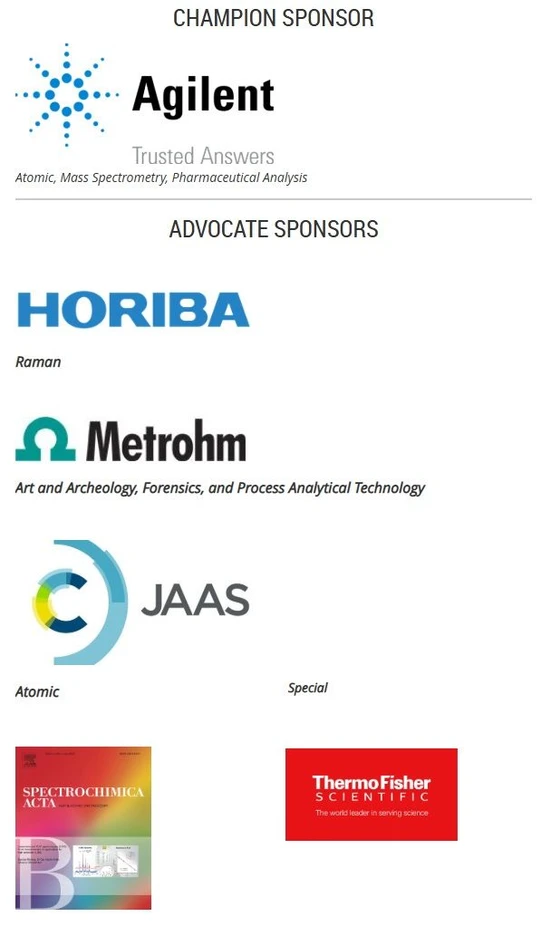 SciX 2025: Sponsors
Media Partners
Premier media partner: Spectroscopy Online
- American Pharmaceutical Review
- The Analytical Scientist
- Applied Spectroscopy
- AuthentiCHEM
- BioPharma Asia
- Photothermal Spectroscopy Corp.
- Pittcon
- Separations