15th International Symposium on Hyphenated Techniques in Chromatography and Separation Technology (HTC-15)
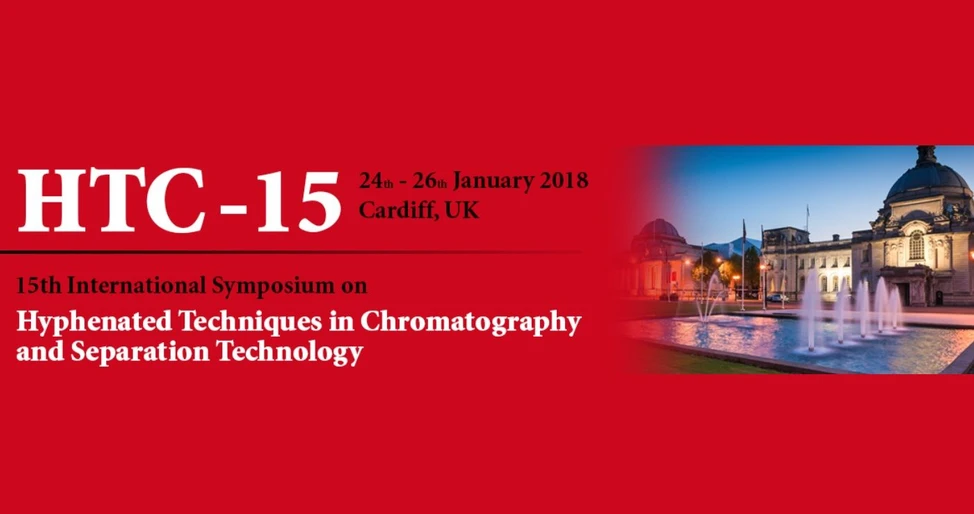
HTC-15 will be the premier conference in hyphenated separation techniques in 2018. With its rich history of successful meetings since 1990 HTC will be hosted at Cardiff City Hall in the heart of the capital city of Wales. The conference has always delivered presentations from internationally renowned experts both from Industry and Academia combined and this will be further enhanced in this edition through joint chairing of the Scientific Committee by Tom Lynch and Peter Schoenmakers.
As previously, HTC-15 covers all fundamental aspects, instrumental developments and applications of hyphenated techniques. Over the three days of the conference there will be three parallel session, including one dedicated to early career researchers (ECRs). Please check the website regularly for updates on the programme and these sessions.
Besides the core scientific programme, the symposium will host an attractive technical exhibition where companies active in the field will present their latest developments in instrumentation, software and applications related to the hyphenation of separation, detection and sample preparation techniques topped with technical seminars.
There will be the usual networking opportunities outside the scientific sessions with a full social programme and conference dinner which will be held at the Museum of Wales.
On behalf of the Organising Committees I look forward to welcoming you to HTC-15 in the historic city of Cardiff and to City Hall, it is the centrepiece of one of the world's finest civic centres, an area of impressive buildings, landscaped gardens and tree lined avenues.
Programme
The conference will include 5 plenary lectures, 16 keynote lectures, 8 tutorial lectures, 48 oral presentations, and daily poster sessions. The programme includes sessions on Big Data, Fundamentals and Exploiting Separation Science, (R)evolutions in Biopharmaceutical Analysis, Food and Drink, Environmental, Comprehensive Chromatography and many more topics relevant to the separation scientist. There will also be a dedicated early-career researchers (ECR) session, with 24 ECR presentations.
Plenary Lectures
Why Do We Still Use Silica?
- Peter Myers, University of Liverpool (UK)
Big Data - The Final Hyphen
- Eric Little, Osthus (USA)
Hyphenated Techniques for comprehensive analysis of all metabolites in biological systems to describe metabolic changes caused by disease, environmental, nutritional, or genetic factors
- Tuulia Hyötyläinen, Örebro University (S)
Of mice, sex and mass spectrometry
- Rob Beynon, University of Liverpool (UK)
Multi-dimensional liquid chromatography of complex mixtures
- Peter Schoenmakers, University of Amsterdam (NL)
Short Courses
INTRODUCTION TO BIOPHARMACEUTICAL ANALYSIS
Presented by world renowned experts in the field of biopharmaceutical analysis, this introductory course covers all major aspects of biopharmaceutical analysis and characterisation. We review the current and future pharmaceutical marketplace as well as examining what constitutes a biopharmaceutical, how they differ from traditional small molecules and their critical quality attributes. We then thoroughly investigate the range of techniques required to fully characterise and analyse these molecules using a wide range chromatographic modes and detection techniques.
Who Should Attend
Those currently involved in biopharmaceutical analysis, those interested in a career analysing and characterising biopharmaceuticals and those looking to move into this field from a small molecule/traditional pharmaceutical background.
Course Outline
- Introduction to biopharmaceuticals - contrasting with small molecules/traditional pharmaceuticals
- Recent evolution of biopharmaceuticals and the biopharmaceutical market
- The production of a biopharmaceutical
- Critical performance characteristics - common co- and post-translational modifications specific to biopharmaceuticals (emphasis on mAbs)
- Overview of techniques employed in biopharmaceuticals analysis
- Detailed review and application areas of the following techniques
- Reversed Phase (covering intact, fragments, peptides and amino acids)
- HILIC (including glycan workflow's)
- Ion exchange
- Size Exclusion Chromatography
- Hydrophobic Interaction Chromatography
- Course summary/conclusions
Tutors
- Dr. Koen Sandra, Research Institute for Chromatography (RIC), Kortrijk, Belgium
- Dr Szabolcs Fekete, University of Geneva, Switserland
- Dr. Tony Taylor, Crawford Scientific and CHROMacademy, United Kingdom.
SUPERCRITICAL FLUID CHROMATOGRAPHY: FROM THEORY TO (INDUSTRIAL) APPLICATION
Presented by world renowned experts in the field of supercritical fluid chromatography (SFC) and pharmaceutical analysis, this introductory course covers all major aspects of supercritical fluid chromatography. The basic theory of SFC and supercritical fluids is reviewed and current available commercial instrumentation is discussed. The different parameters that determine the speed, quality and robustness of SFC separations and method development strategies are illustrated. Practical aspects of the hyphenation of SFC with MS are reviewed. In addition, applications for a wide range of samples are discussed and the use of SFC in an industrial regulated environment is illustrated using practical examples.
Who Should Attend
Everyone interested in using Supercritical Fluid Chromatography as an alternative for their current analysis, or those that are already using SFC, but want a better understanding of the underlying principles of separation performance, retention and selectivity.
Course Outline
- Definition and properties of supercritical fluids
- SFC instrumentation
- Selection of stationary phases, organic modifiers and additives in SFC
- Selection of additives in SFC and analysis of basiccompounds
- How to use pressure and temperature in SFC?
- SFC method development strategy
- Applications of SFC in pharmaceutical, food, environmental,forensic, fragrance... (chiral/achiral, analytical/preparative)
- Kinetic performance and instrumental constraints of modern SFC (UHPSFC)
- Coupling SFC with MS and applications
- Industrial perspective and insights on the use of SFC
Tutors
- Prof. Caroline West, University of Orleans, France
- Dr. Claudio Brunelli, Pfizer Analytical Research and Development, United Kingdom
- Prof. Ken Broekhoven, Free University of Brussels, Belgium
Statistical analysis of chromatographic data: a practical guide
This introductory course covers all main aspects of analysis of chromatographic data. As data analysis lays at the interface between statistics and chromatography, both backgrounds are necessary. In light of this, I will review the range of techniques that are be available for extracting quantitative and qualitative information from chromatography, with emphasis on understanding the do's and don'ts.
Who Should Attend
This course is addressed to those currently involved in any chromatographic sub-discipline, interested in obtaining the maximum information out of the data generated. The audience should have a basic background in statistical analysis. All those working in disciplines in which the data treatment is critical (e.g. forensics, pharma and food) are specially encouraged to attend.
Tutor: Dr. Gabriel Vivo-Truyols Tecnometrix, The Netherlands
VENDOR SEMINARS
- VRS Recruitment Lunch Seminar: Securing YOUR Perfect Job!
- SCIEX Lunch Seminar: Mapping Protein Modifications Using Novel MS Strategies
- ELLUTIA Lunch Seminar: MAX a new concept in GC-FTIR
- SHIMADZU Lunch Seminar: Smart & Green Hyphenated Solutions
Sponsors
Platinum
- Markes International
- SepSolve
Gold
- LECO
- Shimadzu
- Pfizer
- ROMIL
Silver
- Thermo Fisher Scientific
- Waters Corporation
- SCIEX
- HICHROM
- jmp
SYMPOSIUM VENUE
- Cardiff City Hall, Gorsedd Gardens Road, Cardiff, Wales