16th International Symposium on Hyphenated Techniques in Chromatography and Separation Technology (HTC-16)
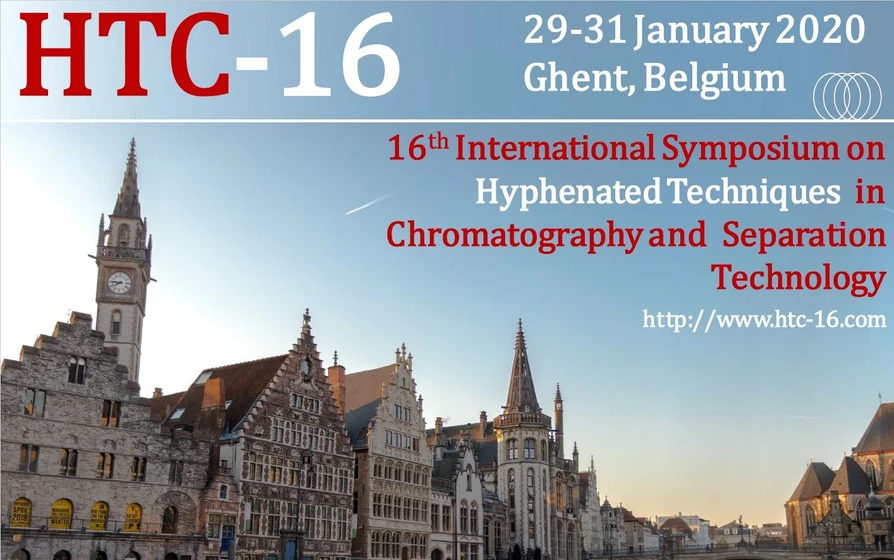
We have the pleasure announcing the 16th International Symposium on Hyphenated Techniques in Chromatography and Separation technology in Conference Center ‘t Pand in Ghent (Belgium) from January 29 till January 31, in 2020. HTC-16 is organized under the auspices of the Royal Flemish Chemical Society (KVCV) and the Royal Society of Chemistry (RSC).
The HTC-16 conference will be the premier platform for state-of-the-art developments in separation technologies and hyphenated techniques. The conference will encompass 3 parallel sessions consisting of plenary lectures, keynote lectures, tutorials, oral and poster-flash presentations. One of the parallel sessions is dedicated to young emerging scientists. The symposium will also host an attractive technical exhibition where vendors present their newest instruments and developments, topped with technical seminars.
We will cover fundamental and practical aspects of liquid-phase and gas chromatography, including UHPLC-MS, 2D-LC, GC(×GC)-MS, SFC, etc. The program will include topics such as sample preparation and hyphenation, advances in method development, establishing high peak capacity and high-throughput analysis, dealing with data complexity, mining and curation. We will also address bottlenecks and describe trends and new technologies for a wide range of applications, including (bio-)pharmaceuticals, medical and clinical applications, food and beverages, environmental studies, energy, etc. Outside the scientific sessions there will be abundant networking possibilities with, amongst others, a beer tasting event and a conference dinner.
Programme
POSTER SESSIONS
Posters should be printed in portrait A0 format. Suitable materials to attach the posters to the board will be provided at the registration office, do not use any other material to attach your poster to avoid damage to the poster boards.
All posters will be on display during the entire conference. Poster have to be set up on Wednesday January 29 between 08:00 and 09:00 and removed on Friday before 14:30. If you don’t remove your poster as mentioned above, the Organizing Secretariat will remove it (Organizing Secretariat assumes no responsibility of problems or damage).
“Posters will be organized according to topic:
- DAT: Data complexity, mining and curation
- FOOD: Advances in food analysis
- FUN: Fundamentals
- GC(xGC): Gas chromatography and GCxGC
- HYP: Hyphenated approaches
- MDLC: Multi-dimensional analysis
- PHA: Advances in (bio)pharmaceutical analysis
- SAM: Sample preparation and introduction
- STA: Developments in stationary phases
- SFC: Advances in supercritical fluid chromatography”
The best poster award winners will be announced on Friday, January 31, 2020 during the Closing Plenary Session at 16:00.
Short Courses
1. MULTIDIMENSIONAL AND HYPHENATED TECHNIQUES IN LC AND GC
- Tuesday January 28th 2020, 09:00 – 17:00
- Speakers: Joeri Vercammen (Ghent University, BE), Dr. Dwight Stoll (Gustavus Adolphus College, USA), Dr. Davy Guillarme (University of Geneva, CH).
In the twenty years of its existence, GCxGC has evolved into a mature technique that enables comprehensive analysis of a complex samples in petrochemistry, food and environmental analysis. Nonetheless, the GCxGC footprint remains relatively small within the entire chromatography sphere. The goal of this training is to provide sufficient insight to convince those in doubt whilst at the same time provide new insights to its early adopters. Therefore, the following topics will be addressed: (a) Origins of GCxGC, (b) The concept of orthogonality, (c) Theory and basic principles, (d) Comparison of modulator technology, (e) Data handling challenges, (f) Recent applications, (g) Q&A. Each participant is encouraged to provide real life challenges he/she is confronted with during
daily routine. These questions will be proactively incorporated into the training to make it even more relevant to everyone attending.
Two-dimensional liquid chromatography (2D-LC) is increasingly becoming recognized as a powerful and flexible analytical tool that can be used in a variety of applications areas, particularly when conventional one-dimensional (1D) separations are inadequate for some reason. Leveraging the potential of 2D-LC requires that users understand the underlying principles of the technique, and differences between 1D and 2D separations in method development. We will address several key concepts from a theoretical point of view, including undersampling, and the different types and modes of 2D separation (e.g., heartcutting and comprehensive separations). Then, we will use examples of contemporary separations of both small molecules (e.g., pharmaceutical impurity profiling) and larger biomolecules (e.g., peptides and proteins) to illustrate both what it is possible, and the steps in method development that are critical to successful separations. Finally, several practical topics will be discussed, including coupling to mass spectrometric detection, quantitation, and data visualization and analysis. We intend for the course to be practical in nature, with a solid theoretical foundation. We encourage attendees to bring any questions they have about separations they are currently doing, or plan to do, for discussion during the course.
2. CANNABIS ANALYSIS
- Tuesday January 28th 2020, 09:00 – 17:00
- Speakers: Dr. Barbara Paccheti (EMMAC) Dr. Gesa Schad, Dr. Allegra Leghissa, Dr. Xaver Monninghoff (Schimadzu), Dr. Hansjörg Majer (Restek), Dr. Flavio Franchina (University of Liège, BE).
Due to recent changes in legislation all over Europe, the medicinal cannabis market continues to grow, and CBD infused edibles, food supplements and cosmetic products are enjoying an unprecedented surge in popularity. Accurate cannabis analysis is required in order to ensure product quality and consumer safety. Cannabinoids are the primary active components of cannabis and the target compounds for potency testing. Terpenes influence the homeopathic effect, and contaminants such as pesticide residues and microbial contamination could cause serious harm, especially to immuno-compromised medicinal cannabis users.
This short course will cover the basics of cannabis and the industry, as well as the stateof-the-art testing methods currently available. In the first part, the basics of cannabis analysis and background on cannabis industry will be discussed. The second part handles basic testing for potency, moisture and mycotoxines, followed by advanced testing for terpenes, pesticides and chemical residues. In the final part of the short course, the analysis of (S)VOC compounds in cannabis is discussed. Speakers from academia (Flavio A. Franchina, Université de Liège), industry (Barbara Pacchetti - EMMAC) and experts from instrument manufacturers (Gesa Schad , Allegra Leghissa and Xaver Mönninghoff – Shimadzu; Hansjörg Majer - Restek), will cover these different topics.
VENDOR SESSIONS
Carotenoids and Apocarotenoids Determination by SFE/ SFC Triple Quadrupole Mass Spectrometry
- Prof. Paola Dugo, Food Chemistry, University of Messina, Italy.
- Wednesday, January 29 at 13:30 – Shimadzu
Mass Analysis Designed for Everyone
- Lilla Guricza, PhD Application Scientist, Agilent Technologies, Waldbronn, Germany.
- Thursday, January 30 at 13:30 – Agilent Technologies
Applying GCxGC to botanical flavour profiling in gin using SPME and Smart Connected GC - Using Self Aware systems to increase productivity
- Onno Kwast, Application Chemist, JSB Netherlands and Remko Van Loen, GC & GC/MS Product Specialist Agilent Technologies.
- Friday, January 31 at 13:30 – Agilent Technologies
Plenary speakers
UHPLC and Prefractionation to Increase Metabolite Identifications in Metabolomics Assays
- Robert Kennedy, University of Michigan, United States of America
Metabolomics and lipidomics assays by LC-MS/MS can produce thousands of detected features. Achieving identification of compounds however has lagged the ability to detect such compounds. In this work, we explore two chromatography-centric approaches for increasing the compound identifications possible. In the first approach we explore use of long columns operated at 2400 bar and above for resolving complex mixtures and the effect of such separations on compound identifications. We find that increasing peak
capacity afforded by columns that are 50 cm long packed with 1.7 um particles results in substantial increases in compounds identifications made by database matching for lipid extracts of plasma. Even higher peak capacity, up to 10,000, by coupling a prefractionation HILIC column (off-line) to a reversed-phase UHPLC columns yields a further, but less dramatic increase in lipid identifications. Our second approach is motivated by the hypothesis that low signals arising from insufficient concentration results in mass spectra of insufficient quality to yield good identification. We explore use of substantial
preconcentration on columns along with prefractionation. A variety of strategies are used, but we find it is possible to increase positive identifications by over 3-fold compared to single dimension UHPLC. Both approaches will be described for analysis of pooled plasma samples.
Nano- and Capillary LC Separations Using Micro-Pillar Array Columns for Maximal Efficiency and Robustness
- Gert Desmet, Jeff Op de Beeck, Geert Van Raemdonck, Kurt Van Mol, Bo Claerebout, Natalie Van Landuyt, Paul Jacob
- Department of Chemical Engineering, Vrije Universiteit Brussel, Brussels, Belgium
As an alternative to the conventional packed bed nano LC columns that are frequently used in bottom-up proteomics research, a breakthrough in column manufacturing recently led to the introduction of silicon-based micromachined nano LC chip columns known as micro pillar array columns (μPAC™). These columns have an inherent high permeability and an unprecedented low ‘on-column’ dispersion due to the perfect order of the separation bed .Due to the perfect order, the peak dispersion originating from heterogeneous flow paths in the separation bed is eliminated (no A-term contributions). Sample components remain therefore much more concentrated during separation resulting in unprecedented separation performance. The freestanding nature of the pillars also leads to much lower backpressure allowing a high operational flow rate flexibility with exceptional peak capacities. In addition, the monolithic nature of the beds makes them extremely rugged and guarantees an unprecedented longevity of the columns. Moreover, it also guarantees run-to-run time repeatability that is about an order of magnitude better than packed bed columns, thus facilitating and accelerating protein identification.
After the introduction of a 200 cm long column, which is ideally suited to perform comprehensive proteome research, a 50 cm long μPAC™ column is now available which can be used in a more routine research setting. With an internal volume of 3 μL, this column is perfectly suited to perform high throughput analyses with shorter gradient solvent times (30, 60 and 90 minute gradients) and it can be used over a wide range of flow rates, between 100 and 2000 nL/min. Recently performed experiments with 500 ng of HeLa cell digest indicate that an increase in protein identifications up to 50% and a gain of 70% in peptide identifications can be achieved when comparing the 50 cm μPAC™
column to the current state-of-the-art packed bed columns. In the recent months, we have also been developing a column that is deeper and wider to meet the requirements of capillary LC flow rate. New data on these columns will be presented at the conference.
Sponsors
Platinum
- Agilent Technologies
- Shimadzu
- Thermo Fisher Scientific
Gold
- RIC group
- YMC Europe GmbH
- Waters Corporation
Silver
- Bruker
- GL Sciences
- Interscience
- JEOL
- SepSolve
- Phenomenex
- PharmaFluidics
Bronze
- LECO
- Anthiad Consulting
- ionBench
- TOTAL
- American Elements
SYMPOSIUM VENUE
- Het Pand
- Onderbergen 1
- 9000, Ghent, Belgium