17th International Symposium on Hyphenated Techniques in Chromatography and Separation Technology (HTC-17)
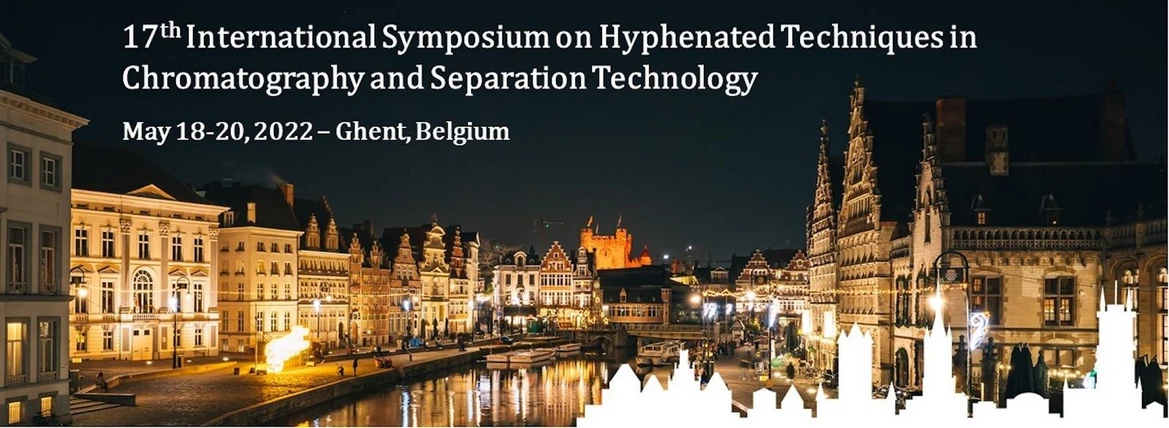
After two challenging years, where we were confronted with the Corona virus pandemic that has severely restricted our means to interact, network and share research, we are happy to announce that we are in advanced preparation of the 17th International Symposium on Hyphenated Techniques in Chromatography and Separation Technology (HTC-17), that will be held in person from 18 to 20 May 2022, at The Aula (Voldersstraat 9) in Ghent, Belgium. HTC-17 will be organized under the auspices of the Royal Flemish Chemical Society (KVCV) and the Separation Science Group of the Royal Society of Chemistry (SSG RSC).
The HTC-17 conference will be the premier platform for state-of-the-art developments in separation technologies and hyphenated techniques. The conference will encompass three parallel sessions consisting of plenary lectures, keynote lectures, tutorials, oral and poster-flash presentations. One of the parallel sessions will be dedicated to young emerging scientists. The symposium will also host an attractive technical exhibition where vendors will present their newest instruments and developments, topped with technical seminars.
We will cover fundamental and practical aspects of liquid-phase and gas chromatography, including UHPLC-MS, 2D-LC, GC(×GC)-MS, SFC, etc. The program will include topics such as sample preparation and hyphenation, emerging detectors, method development and artificial intelligence, column technology and stationary-phase developments, miniaturization and chip technology, dealing with data complexity, mining and curation. We will also address bottlenecks and describe trends and new technologies for a wide range of applications, including (bio-)pharmaceuticals, macromolecules, medical and clinical applications, food analysis and safety, environmental studies, energy, green approaches, etc.
As always, we will ensure abundant networking opportunities during the conference, with an informal beer tasting event organized during a nocturnal poster event and a conference dinner, which will be held in a beautiful monastery.
A number of awards will be presented at HTC-17. The HTC/LCGC Innovation Award, sponsored by LCGC Europe, will be offered to a researcher with less than 15 years’ experience after obtaining his/her PhD for “a pioneering contribution to the field of separation sciences by introducing new methodologies, new instrumentation or new techniques in the field, with a strong focus on applicability”. The most innovative oral contribution presented during the conference will receive the HTC-Award. The most innovative poster contributions will receive the HTC-Poster Award. We will also organize a YouTube contest for young scientists that will be sponsored by Elsevier’s Journal of Chromatography A and Journal of Chromatography Open, a new Open Access journal.
We look forward to welcoming you in person to HTC-17 in the historic city of Ghent!
The HTC-17 Organizing Committee
Programme
POSTER SESSIONS
Posters should be printed in portrait A0 format. Suitable materials to attach the posters to the board will be provided at the registration office, do not use any other material to attach your poster to avoid damage to the poster boards.
All posters will be on display during the entire conference. Posters have to be set up on Wednesday May 18 between 08:00 and 09:00 and removed on Friday before 14:30. If you don’t remove your poster as mentioned above, the Organizing Secretariat will remove it (Organizing Secretariat assumes no responsibility of problems or damage).
Posters will be organized according to topic:
- FOOD: Food analysis / Food safety and trace analysis
- NAT: Natural product analysis
- MACRO: Macromolecule analysis
- ENV: Environmental and pollutant analysis
- SAMP: Sample preparation
- COL: Column Technology and Stationary phase development
- SYS: System design & optimization
- MET: Method development and artificial intelligence, data mining and curation
- OMIC: Omics (lipidomics, metabolomics, proteomics)
- PHA: (Bio-)pharmaceutical analysis (proteins, oligonucleotides, MAbs, viruses)
The best poster award winners will be announced on Friday, May 20, 2022 during the Closing Plenary Session at 15:30.
Short Courses
1. A fundamental and practical look at separation mechanisms beyond RPLC: HIC, HILIC, SFC, SEC, IEX, MM, PGC
- Lecturers: Davy Guillarme, Caroline West
In the ever-changing landscape of Liquid Chromatography (LC), reversed phase (RP) liquid chromatography is still the workhorse for most applications and first choice in method development. There are, however, a large number of applications where RPLC cannot produce an acceptable separation quality and in many instances other separation techniques can provide superior performance than RPLC. The goal of this short course is to provide insight in a selection of these techniques, their underlying mechanisms and applications. These insights will additionally allow for a better selection of orthogonal separation mechanisms for application in multidimensional LC separations.
In the first part of this short course, Davy Guillarme will highlight the basic principles of Ion-exchange (IEX), Sizeexclusion (SEC) and Hydrophobic Interaction Chromatography (HIC). The type of mobile phases and stationary phases will also be described to better understand how retention and selectivity can be tuned. The main applications of IEX, SEC and HIC in the field of small molecules analysis as well as protein biopharmaceuticals will be highlighted, to better understand when those specific chromatographic modes have to be used and what could be the added value over RPLC mode. Finally, the detection modes that can be used with these modes of chromatography will also be critically discussed.
In the second part of the course, David McCalley will discuss Hydrophilic interaction chromatography (HILIC), a complementary LC technique that is particularly suited to the analysis of polar and ionised compounds that tend to be poorly retained in RPLC. While it is simple to apply HILIC in practice, the underlying mechanisms of retention can be more complex and deserve consideration by practitioners interested in method development or evaluation.
This course should enable participants to understand the basis of hydrophilic retention together with contributions from ionic and other processes; how to judge whether a compound is suitable for HILIC separation; how to select appropriate columns and mobile phases and to enable an appreciation of the advantages and limitations of the technique.
In the final part of the course, Caroline West will discuss the possibilities of Mixed-mode chromatography, porous graphitic carbon stationary phases and Supercritical Fluid Chromatography (SFC). Traditional RPLC is mostly done on conventional stationary phases with little chemical diversity (mostly alkyl or aromatic ligands), offering limited possibilities to optimize selectivity. Other, more exotic stationary phases like porous graphitic carbon (PGC) and mixed-mode (MM) stationary phases involve the combined use of two (or more) retention mechanisms in a single chromatographic system (e.g. RP and HILIC, RP and IEX, etc.). An overview of the current knowledge on these stationary phases, their complementarity to RPLC and sample applications will be proposed. SFC on the other hand uses mobile phases composed of pressurized carbon dioxide and a liquid co-solvent. It uses all stationary phases normally employed in HPLC (from polar silica gel to non-polar C18-bonded silica), for achiral and chiral separations.
The basic theory of SFC will be explained, then guidelines to select the operating conditions based on the analyte nature will be given. Specific applications will be presented, especially the transfer of HPLC methods to SFC.
2. Capillary Electrophoresis-Mass Spectrometry for Metabolomics: Principles and Applications
- Lecturers: Rawi Ramautar, Marlien van Mever
The main objective of this course is to provide you with an overview of the main capillary electrophoresis-mass spectrometry (CE-MS) approaches used in bioanalysis and metabolomics, including their working/separation
mechanisms.
The course is composed of both lectures and cases showing in particular the applicability of CE-MS for volumerestricted biological samples and for compound classes that are (still) difficult to analyze with chromatographicbased separation techniques. Lectures are focused on explaining the basics of the various capillary electrophoresis separation modes and on the use of coated capillaries for specific bio-analytical applications. Ample attention is devoted to the coupling of CE to MS using both the classical and the recently developed interfacing designs. The possibilities enabled by CE-MS using improved interfacing designs is shown for challenging, material-limited biological questions. The reproducibility of CE-MS for metabolomics studies is also considered by highlighting the Metabo-Ring trial.
The utility of the state-of-the-art CE-MS approaches in metabolomics is demonstrated by discussing a few recent studies in more detail. For example, it is shown that neurotransmitters can be directly analyzed in rat microdialysis
samples without using derivatization and sample pretreatment. Highly polar metabolites, such as ATP, ADP and AMP, can be analyzed in extracts from just a limited number of mammalian cells with an exquisite detection sensitivity, opening up the possibility to assess the adenylate energy charge in studies dealing with microscale cell cultures. Finally, the potential of CE-MS for large-scale and quantitative clinical metabolomics studies is also addressed. This course is given in an interactive way by using tools such as for example the Mentimeter.
Plenary Spekares
Translation of biomarkers to clinical assays: lessons from COVID and Joy?
- Perdita Barran, Manchester Institute of Biotechnology, The University of Manchester, United Kingdom
Recent advances in medical applications of GC×GC
- Jef Focant, Organic and Biological Analytical Chemistry Group, University of Liège, Belgium
The favourable features of hydrophilic interaction chromatography (HILIC) as a complimentary technique to reversed phase (RPLC)
- David McCalley, University of the West of England, United Kingdom
Hyphenation for large-molecule samples
- Peter Schoenmakers, Van ’t Hoff Institute for Molecular Science (HIMS), University of Amsterdam
Sponsors
Platinum
- Agilent Technologies
- PerkinElmer
Gold
- Shimadzu
- RIC group
- YMC Europe GmbH
- LECO
Silver
- GL Sciences
- Interscience
- JEOL
- SepSolve
- Janssen Pharmaceutical Companies of Johnson & Johnson
- MERCK
- SCIEX
- HyperChrom
- RESTEK
Bronze
SYMPOSIUM VENUE
- De Aula
- Voldersstraat 9
- 9000 Ghent, Belgium
SHORT COURSE VENUE
- Novotel
- Hoogpoort 52
- 9000 Ghent, Belgium