Complexation of Plutonium and Other Actinides in Different Oxidation States with Gluconate at Low pH Values─A CE-ICP-MS Study
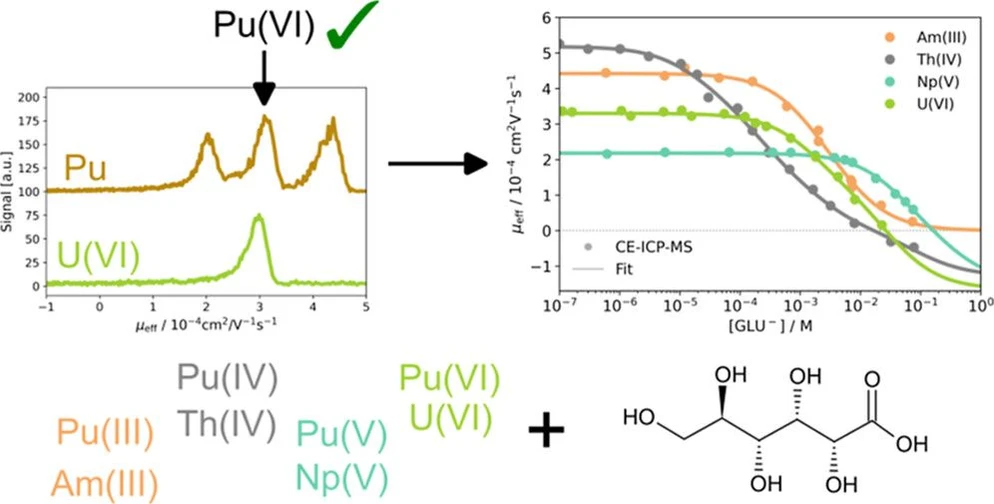
Inorg. Chem. 2026, 65, 7, 3806–3814: Graphical abstract
This study employs CE-ICP-MS to investigate the complexation of plutonium in oxidation states III–VI with gluconate at acidic pH, alongside analogous actinides including americium, thorium, neptunium, and uranium. Electrophoretic mobility measurements enabled characterization of complex formation and comparison of plutonium behavior with its redox analogues.
The results showed similar complexation behavior for Pu(III), Pu(V), and Pu(VI) relative to corresponding actinides, while Pu(IV) exhibited distinct interactions involving mixed hydroxide–gluconate species. The findings provide new insight into actinide speciation and bonding mechanisms, demonstrating differences between tetravalent and actinyl ions and highlighting the value of CE-ICP-MS for studying radionuclide chemistry.
The original article
Complexation of Plutonium and Other Actinides in Different Oxidation States with Gluconate at Low pH Values─A CE-ICP-MS Study
Janik Lohmann, Felix Sprunk, Diana Velikotrav, Alexander Wiebe, Julia Zemke, and Tobias Reich*
Inorg. Chem. 2026, 65, 7, 3806–3814
https://doi.org/10.1021/acs.inorgchem.5c04403
licensed under CC-BY 4.0
Selected sections from the article follow. Formats and hyperlinks were adapted from the original.
Gluconic acid is considered to be one of the most important organic ligands that could influence the mobility of radionuclides in the near field of a potential low or intermediate level nuclear waste repository. (1)
Through its use as a potential cement additive, gluconate can be released during cement degradation. Several studies have already demonstrated the influence of gluconate on the retention of tri- and tetravalent actinides under conditions relevant to the nuclear waste repository. (2−6) Furthermore, large quantities of sodium gluconate were introduced at the Hanford site as part of the Manhattan project. (7)
Plutonium is responsible for a large part of the radiotoxicity in spent fuels. (8) Due to the complicated redox chemistry, studies with plutonium require a high degree of redox control. (9) This is probably one of the reasons that there are only a few studies with Pu, especially at low pH values. In the literature, mainly redox-stable actinides have been investigated as analogues of Pu in different oxidation states.
Most studies regarding the influence of gluconate under repository-relevant conditions were conducted at alkaline or hyperalkaline pH values, which are expected during cement aging. Under the reductive conditions in the repository, actinides predominantly occur in the oxidation states +III and +IV. In literature, gluconate complexation has therefore mainly been investigated with Th(IV) (3,5,10) or U(IV) (11) as a representative of An(IV) and with Am(III), (10) Cm(III), (6) or Eu(III) (10) as representatives of An(III). For An(VI), the complexation of U(VI) (12,13) with gluconate was investigated. To our knowledge, no studies on the complexation of An(V) with GLU in an alkaline solution exist. The complexation of plutonium with GLU was only ever investigated for Pu(IV). (5) At high pH values, hydrolysis of An and the formation of mixed An–OH–GLU complexes occur. (5,6,14) Although the second pKa of gluconic acid is approximately 13 ± 1, (15) metal-induced ligand deprotonation can occur in the metal complex, resulting in the abstraction of one or more of the alcohol protons at significantly lower pH values. (14,16,17) All of these effects complicate the determination of thermodynamic data.
In order to investigate mainly the binary An–GLU complexation, experiments in this work were performed at pH ≤ 4. The investigations were carried out using a combination of capillary electrophoresis (CE) and ICP-MS. In our previous work, good agreement between CE-ICP-MS and TRLFS was achieved for the Eu(III)–GLU complexation. (14)
Zhang et al. systematically investigated the complexation of Nd(III), (18) Th(IV), (7) Np(V), (19) and U(VI) (17) with gluconate under similar conditions to this work using a combination of potentiometry, spectrophotometry, nuclear magnetic resonance (NMR) spectroscopy, and extended X-ray absorption fine structure (EXAFS) studies. They described the formation of binary complexes with up to three gluconate ligands for Nd(III), (18) two for Np(V), (19) and one for U(VI). (17) For Th(IV) (7) and U(VI), (17) Zhang et al. proposed the formation of hydroxyl-deprotonated gluconate complexes even at low pH values.
In this work, the ability of CE-ICP-MS to measure multiple analytes simultaneously was used to confirm the desired Pu oxidation state by comparing the electrophoretic mobility with that of a redox-stable actinide. Thus, gluconate complexation was investigated for the pairs Am(III)/Pu(III) and Np(V)/Pu(V) at pH 4, U(VI)/Pu(VI) at pH 3, and Th(IV)/Pu(IV) between pH 1.3 and 2.7.
2. Experimental Section
2.3. CE-ICP-MS
All CE measurements were performed using an Agilent 7100 CE system (Agilent, Santa Clara, California, USA) hyphenated to an Agilent 7900 ICP-MS system (Agilent, Santa Clara, California, USA). The coupling was realized via a MiraMist CE Nebulizer (Burgener Research, Mississauga, Canada) and a Scott-type spray chamber (AHS Analysentechnik, Tübingen, Germany). A fused silica capillary (TSP0503753, Polymicro Technologies, Phoenix, Arizona, USA) with a 50 μm inner diameter and a 50 cm length was used. A voltage of +10 kV and a pressure of 90 mbar were applied to aid the electro-osmotic flow (EOF). The temperature was kept at 25.0 ± 0.1 °C using internal air cooling of the CE device as well as a custom-built enclosure for the hyphenation.
3. Results and Discussion
3.1. Determination of Complexation Constants
3.1.1. Am(III)/Pu(III) Gluconate
The measured electrophoretic mobilities of Am(III) and Pu(III) at pH 4 as a function of the free gluconate concentration [GLU–] are shown in Figure 3. Both actinides exhibit a reduction in electrophoretic mobility with increasing gluconate concentration caused by the formation of An(III)–GLU complexes and, thus, a reduction in mean ionic charge. Under the experimental conditions, the electropherograms measured at low GLU concentrations were dominated by peaks of Pu(III) with a similar electrophoretic mobility as of Am(III) (Figure S7, Supporting Information). With an increase in GLU concentration, peaks with neutral or negative mobilities dominated, potentially corresponding to Pu(IV)–OH–GLU species. Despite that, nearly all samples showed a peak of Pu(III) with a mobility similar to that of Am(III).
![Inorg. Chem. 2026, 65, 7, 3806–3814: Figure 3. Plot of the measured electrophoretic mobilities μeff of 241Am(III) and 239Pu(III) against the free gluconate concentration [GLU–] at pH 4 and I = 0.1 M (NaClO4). Fits include the 1:1 through 1:3 An(III)–GLU complexes using eq 5; R2Am(III) = 0.995 and R2Pu(III) = 0.996.](https://icpms.labrulez.com/labrulez-bucket-strapi-h3hsga3/Inorg_Chem_2026_65_7_3806_3814_Figure_3_Plot_of_the_measured_electrophoretic_mobilities_15c44ffdad_l.webp) Inorg. Chem. 2026, 65, 7, 3806–3814: Figure 3. Plot of the measured electrophoretic mobilities μeff of 241Am(III) and 239Pu(III) against the free gluconate concentration [GLU–] at pH 4 and I = 0.1 M (NaClO4). Fits include the 1:1 through 1:3 An(III)–GLU complexes using eq 5; R2Am(III) = 0.995 and R2Pu(III) = 0.996.
Inorg. Chem. 2026, 65, 7, 3806–3814: Figure 3. Plot of the measured electrophoretic mobilities μeff of 241Am(III) and 239Pu(III) against the free gluconate concentration [GLU–] at pH 4 and I = 0.1 M (NaClO4). Fits include the 1:1 through 1:3 An(III)–GLU complexes using eq 5; R2Am(III) = 0.995 and R2Pu(III) = 0.996.
3.2. Comparison of Complexation Constants
The complexation of f-elements is of an electrostatic nature. (28) Ligands with the same bonding motif often follow a linear trend in complexation strength based on the effective charge zeff of the f-element. This is the case for the 1:1 acetate complexes of Pu(III), (29) Am(III), Th(IV), (26) Np(V), U(VI), (30) and Pu(VI). (31) Ca(II) (32) was added for comparison. In Figure 7, log β0 is plotted against the effective charge of each metal cation, (28) exhibiting a linear trend. In general, EXAFS studies show a bidentate coordination of the acetate ligand to the actinide. (33−36)
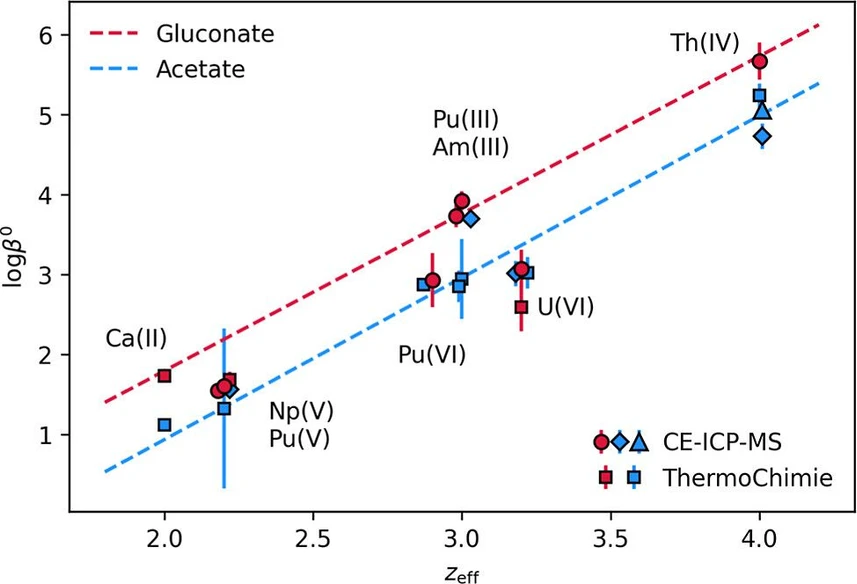 Inorg. Chem. 2026, 65, 7, 3806–3814: Figure 7. log β0 values of the 1:1 acetate and gluconate complexes plotted against the effective cationic charge. (28) For better readability, overlapping points were shifted by zeff = ±0.02. Values determined in this work are marked by circles, values determined using CE-ICP-MS by Willberger et al. (30) and Lohmann et al. (26) are marked by diamonds and triangles, respectively, and values taken from the ThermoChimie V13a database are marked by squares (references in Table S9, Supporting Information). Gluconate complexes are red and acetate complexes are blue.
For the gluconate complexation, an interesting effect is observed. Ca(II), An(III), and Th(IV) show a linear trend with an increased complexation strength compared to acetate, while An(V) and An(IV) fall on the trend of acetate complexation. This was also noticed by Zhang et al. for U(VI). (17)
An(V) and An(VI) are both present as actinyl moieties [AnO2]z+. Two covalently bonded oxygens are linearly arranged with the metal cation, which allows ligands to bind only in the equatorial plane. For An(III) and An(IV), gluconate is expected to form a stronger tridentate bond, (7,14) which seems to be sterically hindered for An(V) and An(VI). The similar complexation constants for the acetate and gluconate complexes of An(V) and An(VI) suggest a similar bidentate bonding motif through the carboxylic function of both acid anions. This is supported by the EXFAS measurements of U(VI)–GLU. (17) It has to be noted that Willberger et al. (30) determined a higher log β0 for [Am(AcO)]2+ compared to previous literature, which in turn is similar to the log β0 for [Am(GLU)]2+ determined in the present work.
4. Conclusions
Using the coupling between capillary electrophoresis and ICP-MS, it was possible to investigate the gluconate complexation of the major Pu oxidation states from (III) to (VI) as well as the redox stable actinides Am(III), Th(IV), Np(V), and U(VI). By addition of a redox stable actinide to the Pu sample, the oxidation state of Pu could be verified by comparing the electrophoretic mobilities. This way, the complex formation constants of three successive binary [An(GLU)x]3–x (x = 1–3) complexes could be determined for Am(III) and Pu(III). For Np(V) and Pu(V), the complex formation constants of the first binary [AnO2(GLU)](aq) complex were determined and those of the second [AnO2(GLU)2]− complex were estimated. For U(VI) and Pu(VI), the constants of the [AnO2(GLU)]+, [AnO2(GLU–H)](aq), and [AnO2(GLU–H)(GLU)]− complexes were determined. Using CE-ICP-MS, it was possible to validate/confirm previous log β0 values for the complexation of the redox analogues Np(V) and U(VI), but at much lower actinide concentrations than before, i.e., at 2 × 10⁻⁷ M. The corresponding complexation constants for Pu were determined for the first time.
Plutonium in the oxidation states (III), (V), and (VI) behaved very similar to the corresponding redox analogous actinides. This was not the case for Th(IV)/Pu(IV). Here, the first five binary [Th(GLU)x]4–x (x = 1–5) complexes were determined for Th(IV), whereas mixed Pu–OH–GLU complexes were proposed for Pu. The comparison of the first complex formation constants of the An–GLU complexes suggests a different bonding motif between An3+/4+ and AnO2+/2+, with AnO2+/2+ forming the weaker complexes.