Matrix CRM of agricultural soil METRANAL® CRM AN-ZP01 and AN-ZP02
ANALYTIKA: Blue line of CRM standards
The set of soils consist of two natural agricultural soils differing in elemental composition
- AN-ZP01: Heavy loam with normal analyte levels
- AN-ZP02: Silty clay loam contaminated with some heavy metals
Contents of element extractable fractions with aqua regia according to ISO 11466
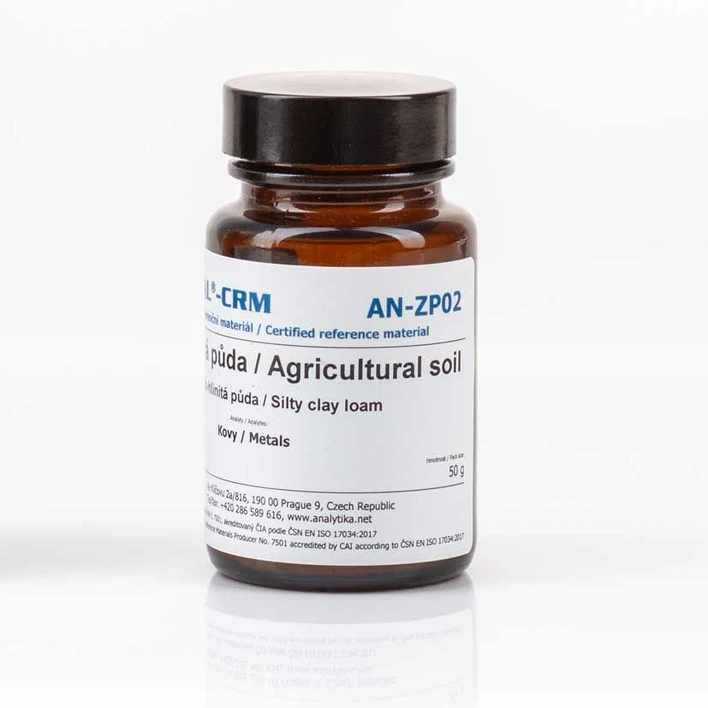 ANALYTIKA: Matrix CRM of agricultural soil METRANAL® CRM AN-ZP01 and AN-ZP02
Packing:
- 50 g of powder of the respective soil with a particle size of less than 100 µm in amber glass bottle.
Intended use:
This set of certified reference materials is intended primarily for use in realizing metrological traceability, validation of analytical methods and the transfer of property values to other materials of similar composition.
Recommended analytical methods for method dependent measurements:
- Flame AAS, ETA-AAS, ICP-OES, ICP-MS, AMA-254
Metrological traceability:
Metrological traceability is realized by using certified calibration standards solutions for the calibration of measurement methods used (direct traceability to SI unit) and/or by simultaneous analysis of a matrix CRM (RM) of similar composition.
Sample preparation (aqua regia extract according to ISO 11466):
Weigh a 3 g (± 0.001 g) sample into a 100 ml round bottom flask. Add a small amount of water (2 to 3 ml) to obtain a slurry, then 7.5 ml of conc. HNO3 (density 1.40 g/ml). Let the mixture stand until intensive foaming ceases, then add (in several portions) 22.5 ml of conc. HCl (density 1.19 g/ml), shake the mixture manually, cover the flask with a watch glass, and let stand for 16 hours (overnight) at the laboratory temperature (20 ± 2°C). Then mount a reflux condenser (a Dimroth type or similar) of about 40 cm length on the top of the flask and boil gently under reflux for 2 hours. After cooling, rinse the condenser with 20 ml of warm (~ 50°C) dilute nitric acid (5%, v/v), the liquid being collected in the round bottom flask. Remove the condenser and filter the solution from the flask through an acid-resistant high density paper filter and collect it in a 100 ml volumetric flask (make sure in preliminary tests that a suitable filter was chosen, so that the filtrate is clear). Rinse the filter and the residue three times with 5 ml of warm (~ 50°C) dilute nitric acid (5%, v/v); allow to cool and dilute with nitric acid 5% (v/v) to the mark. Transfer immediately the solution from the volumetric flask into a clean, dry 100 ml polyethylene bottle. Realize three blanks using exactly the same analytical procedure.
It is acceptable to realize the operation described above in a glass beaker covered with a watch glass. Minimum sample size for analysis is defined with the prescribed working procedure.
Storing and instruction for use:
These CRM have to be stored in original bottle and between 5-30°C (in a dark and dry place). The materials should be analysed in the "as received" state and their dry weight should be determined on non-analysed aliquots oven-dried at 105°C till the constant weight. The material in the bottle must be rehomogenized before each use by mechanical shaking of the content for 1-2 minutes. The bottle should be opened a minimum of 2 minutes after rehomogenization in order to prevent an escape of fine powder particles from the bottle into the environment and their sedimentation.
Certified and indicative values and their uncertainties:
The certified and indicative values of extractable element fraction are summarized in Table 1. The overall means evaluated have been given a status of certified and indicative values using the following criteria: data should be available from at least two independent analytical methods, at least 5 and 3 accepted laboratory means should be available for calculation of the overall mean for certified and indicative value, respectively. At combined uncertainties presented, the contribution of uncertainty of characterization of a particular property value is dominant.
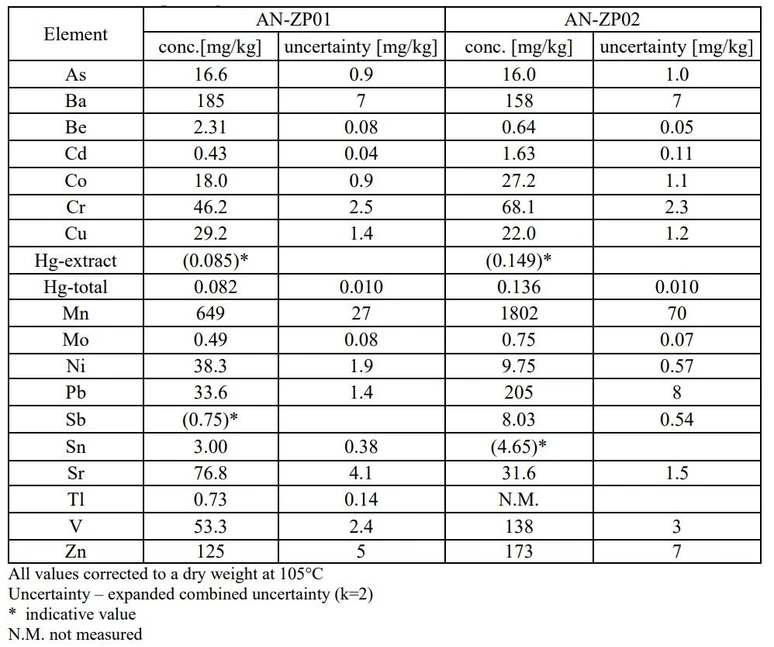 ANALYTIKA: Table 1 - Certified and indicative values of contents of element fractions extractable by aqua regia in CRM AN-ZP01 and AN-ZP02 and their associated uncertainties.
Chemical composition of soil matrix:
The bulk composition of CRM AN-ZP01 and AN-ZP02 is shown in Table 2. The values presented in this table are not certified, but they may be useful for considerations concerning possible interferences while determining analytes given in Table 1, and for selection of suitable decomposition procedures if destructive analytical methods are to be used.
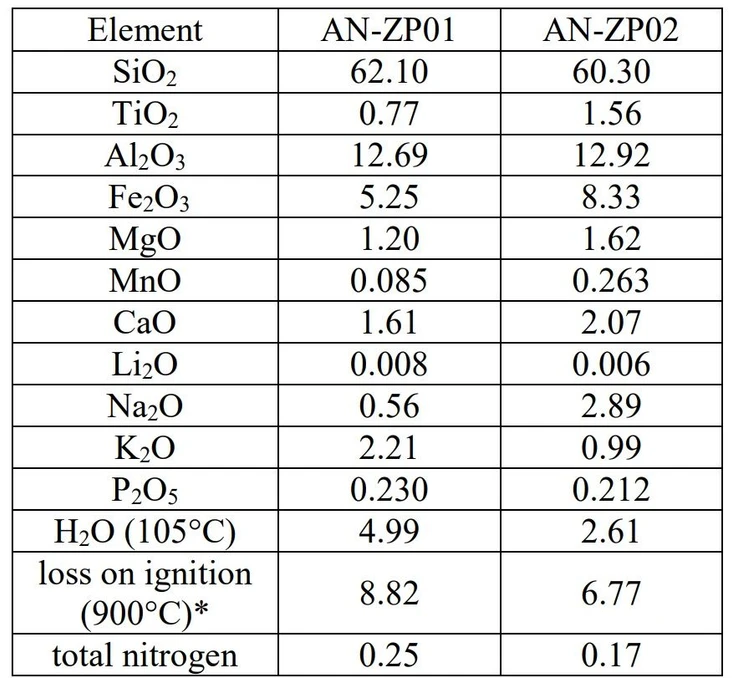 ANALYTIKA: Table 2 Matrix composition of CRM AN-ZP01 and AN-ZP02 (% of the oxides dry weight at 105°C)
Note:
Detailed information about the production, homogeneity testing and characterization of these CRM are described in the Certification report, which is available on request.