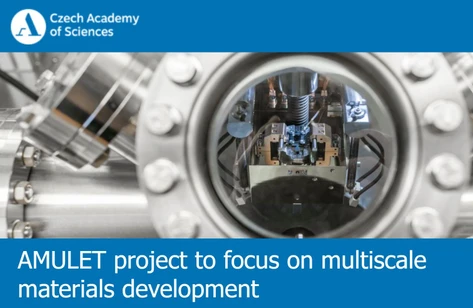
Thomas Gouder: I want the project to continue. The surface research instrument is being relocated from Karlsruhe to Prague
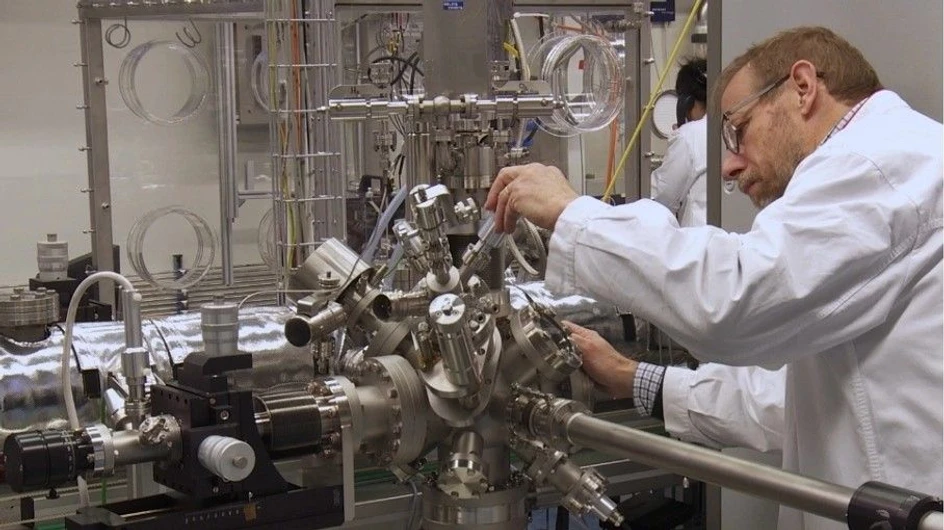
Institue of Physics of the Czech Academy of Sciences: Thomas Gouder with the modular system for surface research at JRC Karlsruhe.
Thomas Gouder’s life's work at the European Commission's Joint Research Centre in Karlsruhe (JRC) is a state-of-the-art modular system for surface science. The instrument, used for cutting-edge research on nuclear fuel safety, corrosion, catalysis, and actinide chemistry, has served scientists from all over Europe, including teams from Prague. How does it work, why is it being moved to Prague, and what lies ahead for its future?
FZU AV ČR: Thomas Gouder with the modular system for surface research at JRC Karlsruhe.
The Rare Earth and Actinides Science Group of FZU, led by Evgenia Chitrova, used the instrument in Karlsruhe for many years within the framework of JRC’s open access programme to research infrastructures. The group focuses not only on the development of special actinide compounds relevant to the field of nuclear materials, but also employed the instrument for the preparation of actinide magnetic materials intended for the study of complex magnetic phenomena, such as the so-called exchange-bias effect, which plays a key role in the development of modern memory technologies.
At present, the transfer of the instrument is being carried out as a joint effort of the JRC and FZU teams. In Karlsruhe, it is being dismantled by JRC staff together with technical specialists from the group of Jan Lančok, who is also securing the facilities for its installation at FZU. All the necessary transfer documentation, in accordance with the relevant legislation, is being prepared by Evgenia Chitrova’s group.
Once installed, the instrument will become the core of the newly established Surface Science Laboratory. More about the instrument for surface research can be found below in the interview with Thomas Gouder.
You worked in the field of nuclear research, which is a controversial topic in Germany...
Even countries like Germany, which have decided to phase out nuclear energy, still need to maintain knowledge, expertise, and research in this field. Nuclear energy is not just a matter of energy production in power plants, but also involves waste management, decommissioning, and application in healthcare, e.g., the treatment of cancer and other diseases with radionuclides.
The decay of nuclear fuel can be studied for a long time after power plants are decommissioned. What actually happens to it during storage?
Research on nuclear fuel is absolutely essential for safety. However, it is not just about nuclear waste, its corrosion and long-term storability, but about the entire nuclear fuel cycle. Surface reactions on materials play an important role: the stability of surfaces, material exchange with the environment, and many other factors depend directly on their reactivity and chemical properties.
Nuclear reactions generate many new elements and compounds, and the chemical behaviour of such systems is often studied using simplified model systems. These can be assembled in the laboratory, where individual parameters are systematically varied – so-called single-effect studies. In one such study, we simulated accident conditions by depositing sodium onto uranium oxide to better estimate potential risks. In another case, we applied metallic palladium to various uranium oxides to investigate its effect on the corrosion behaviour of nuclear waste. Palladium was used because it is produced in reactors through uranium fission and can modify stability of nuclear waste.
These are just two examples of surface systems that can be prepared in our apparatus. Thanks to its modular design, it is very flexible and can be quickly adapted to new applications.
Should research in general focus more on practical applications?
We often hear that focusing on applications limits scientific freedom, but I don't see it that way. Science is done either because people are interested in a particular issue, i.e., knowledge for its own sake, or because it has practical applications or can help solve a problem. Today's basic research may become tomorrow's applied research; the two are not mutually exclusive. That is why we designed our equipment to serve both purposes.
In basic research, it can determine the parameters of the electron structure of materials and their surfaces. In applications, it allows us to simulate catalysis, hydrogen production, corrosion, or estimate the long-term stability of nuclear waste. Our research at JRC could never be purely basic research; it always had to deliver a direct benefit for society.
You started out as a chemist, but then you focused more on physics. What led you to that change?
Chemistry deals with substances, their properties, and production, but the techniques it relies on are based on physical methods, such as e.g. surface spectroscopy or the evaporation processes. Chemistry and physics therefore complement one another: chemistry defines the goal, and physics develops concepts to achieve it. I have always been fascinated by concepts such as what exactly happens on the surface of solids, where atoms are bound on one side but free on the other. How do these atoms react with the external environment?
Putting such concepts to the test in practice, when an abstract idea suddenly takes shape – has always fascinated me, even outside of science. The machine we are transfering to Prague serves precisely this purpose: to prepare surfaces, check their composition and properties, and perform chemical reactions such as catalysis, corrosion, etc.
Metro for samples
The machine is equipped with a special transport system – a “metro”. What does it look like?
Our system consists of an eight-meter-long central vacuum tube to which various modules are attached. In these modules sample synthesis, analysis, and reactions are performed. Samples are transferred between modules in a central tube, transported on a small cart that runs on a rail system. The cart has six wheels, is powered by a magnet, and, uniquely, the drive system is located outside the vacuum. There are no complex mechanical components inside that require maintenance. It is a very simple but effective principle. So this is our "metro," and the modules are stations, even with names similar to metro stations – for example, the train runs from the Deposition 1 station to the Atomic Chamber station.
How much can the cart carry?
The cart has space for six sample plates (2 × 2 cm). In terms of weight, that's very little; we work with thin layers several atoms thick corresponding to a few nano- to micrograms.
And how many atomic layers do you usually deposit?
Only a few atomic layers are deposited – typically fewer than 100. That corresponds to a layer thickness of a few nanometers, or millionths of a millimeter. With this device, we conduct surface research, examining the very topmost atomic layers of solids and how they react with the environment – mainly their corrosion behaviour or catalytic activity. Because of this focus, the research methods are surface-sensitive: we can probe a few atomic layers deep into the material. For example, we might use gold foil as the substrate material and cover it with a thin film of 10 atomic layers. We can still detect gold using our spectroscopy, but the signal is weaker than with pure gold, and it is precisely from this attenuation that we can determine the thickness of the surface layer.
Due to the extreme sensitivity of the surfaces, the instrument must be operated in an ultra-high vacuum (UHV) conditions. Even at a pressure of one billionth of atmospheric pressure (10-9 atm), reactive surfaces would become completely contaminated within a second. That is why all modules and transport systems operate in UHV mode.
Do any sample atoms remain in the chambers?
Yes, this is called "cross-contamination". Since we carry out many different experiments in the chambers, material transfer can occur. We detect such problems using our spectrometers and respond accordingly. It is very important to work carefully and perform thorough cleaning.
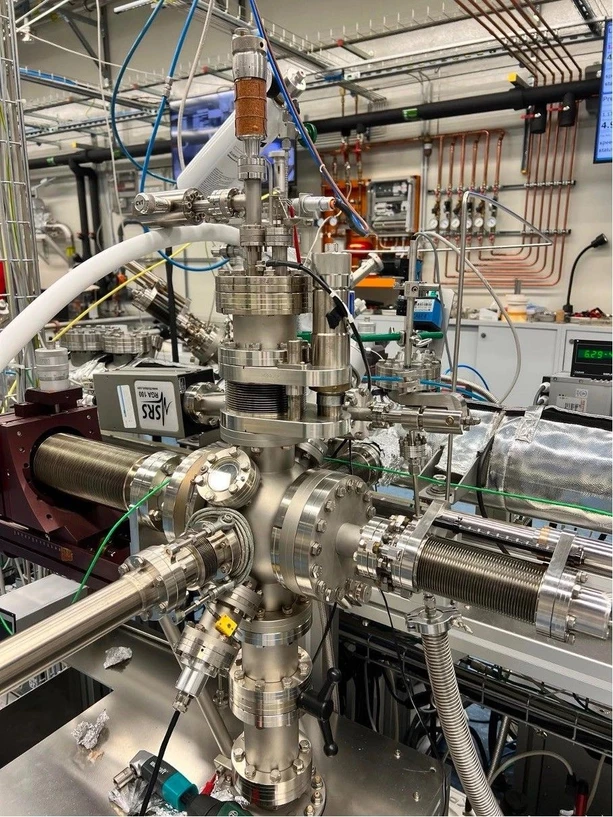 FZU AV ČR: A cutting-edge modular system for surface research is moving from JRC Karlsruhe to Prague.
Surface Science Laboratory now also in Prague
Why is the equipment now coming to the Institute of Physics of the Czech Academy of Sciences in Prague?
In connection with the termination of Surface Science LabStation (SSLS) operations at JRC Karlsruhe and my retirement, a new role was sought for this unique device so that it could continue to serve the European scientific community. A pilot project, SSLS-Lab, was launched, which for the first time makes it possible to transfer top-level research equipment outside the JRC.
As part of an open competition of the European Commission, the equipment was offered to institutions that offer high-quality professional facility and a promising program for its future use. A consortium led by the Institute of Physics of the Czech Academy of Sciences, with the participation of the Faculty of Mathematics and Physics of Charles University, the Faculty of Nuclear Sciences and Physical Engineering of the Czech Technical University in Prague, and the J. Heyrovský Institute of Physical Chemistry, submitted a proposal that successfully prevailed over other European applicants – thanks in particular to the quality of the scientific programme, the laboratory’s readiness, and the international reach of its activities.
It is important for me that the project continues, and I am convinced that in Prague it is in good hands. We developed the modular system in Karlsruhe and, as part of our "Userlab" project, and from the very beginning we worked closely with Ladislav Havela from the Faculty of Mathematics and Physics at Charles University and Evgenia Chitrova from FZU. Both are very familiar with the system, and I sincerely hope that they will continue to work in the spirit of our institute. I am glad that the apparatus remains part of access scheme for scientists from other laboratories, called the JRC-Userlabs
What research would be particularly important for you in the future?
The modular device is in a way a result of my life's work, and I sincerely hope that it will continue to be used at FZU, especially in interdisciplinary research. The apparatus uniquely integrates surface synthesis, reactions, and analysis, combining chemical and physical aspects. Today, we would call it interdisciplinary. I hope that, in addition to the physics that Evgenia and Ladislav are working on, the chemical applications for which the system was originally designed will not be neglected. Moreover, thanks to its modular design, this system is very easy to operate and modify for new applications. Its great technical advantage is that we can prepare and study the samples we examine "in situ," i.e., without having to move them between devices. We have developed a unique miniature sputtering source for this purpose, which is part of the device and has been used to prepare our films for 20 years.
You mentioned that you are already retired. How do you spend your time now?
I devote part of my time as an active JRC senior, helping with the relocation of the apparatus to Prague. Otherwise, I have many other interests, for example, I am a hobby winemaker and produce 300 to 400 litres of Pinot Noir and Pinot Blanc annually. Work in the vineyard and winery is truly a science in itself, and just like with our instrument, an incredible number of parameters must be taken into account – being dependent on the environment and the weather. Unfortunately, however, it is only possible to conduct one experiment per year.
Thomas Gouder received his PhD in chemistry from the University of Namur in Belgium in 1987 with a dissertation focusing on the relationship between electron structure and surface reactivity. After a prestigious postdoctoral fellowship at Lawrence Livermore National Laboratory (USA), he joined the Institute for Transuranium Elements in Karlsruhe (now JRC Karlsruhe) in 1992, where he worked until his retirement in 2024. At JRC, he introduced thin-film methods for studying the reactivity and electron structure of actinides. He gradually expanded his research focus from surface chemistry to physical studies of complex systems with 5f electrons, including the Kondo effect and localization phenomena, even in highly radioactive elements such as americium and curium. He also addressed topics important for nuclear fuels and waste, such as corrosion influenced by fission products. He is the author or co-author of more than 130 scientific papers. In addition to his cutting-edge knowledge in the fields of physics and chemistry, he also excelled in his deep practical experience in ultra-high vacuum technologies, plasma processes, and electronics, which enabled him to continuously improve experimental apparatus and push the boundaries of research.


_s.webp)