ICPMS
More information
WebinarsAbout usContact usTerms of use
LabRulez s.r.o. All rights reserved. Content available under a CC BY-SA 4.0 Attribution-ShareAlike
Author
LabRulez
LabRulez
Everything from the world of analytical chemistry in one place. We connect people in solving their problems. At Labrulez you will find all the necessary information easily, quickly and clearly. Stop searching and start finding.
Tags
Scientific article
Health
LinkedIn Logo

High-throughput mercury speciation analysis of breast milk using HPLC-ICP-MS

Mo, 10.3.2025
| Original article from: Microchemical Journal, Volume 211, April 2025, 113142
This study developed an HPLC-ICP-MS method to quantify Hg²⁺ and MeHg⁺ in breast milk, evaluating collection methods, total mercury correlation, and elemental associations in samples over a 4-month study.
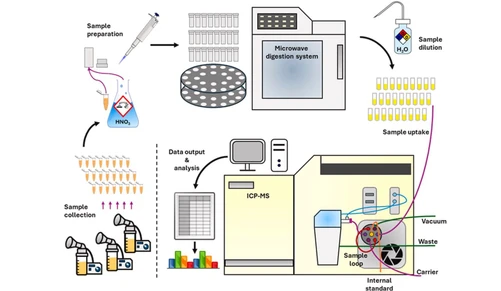
<p>Microchemical Journal, Volume 211, April 2025, 113142: Graphical abstract</p>

Microchemical Journal, Volume 211, April 2025, 113142: Graphical abstract

This study aimed to develop a high-throughput HPLC-ICP-MS method for the simultaneous quantification of inorganic mercury (Hg²⁺) and methylmercury (MeHg⁺) in human breast milk. The method was validated using a certified reference material, achieving 99% accuracy.

A 4-month analysis of breast milk samples from 10 participants examined the effects of collection method and timing on mercury speciation. The results revealed correlations between mercury species, fat content, and selenium, with MeHg⁺ concentrations being higher in hindmilk. The study highlights the importance of accurate mercury speciation and proper breast milk collection methodologies.

The original article

High-throughput mercury speciation analysis of breast milk using HPLC-ICP-MS

Kenta Iwai, Miyuki Iwai-Shimada, Nozomi Tatsuta, Yayoi Kobayashi, Kaname Asato, Mitsuo Nishimoto, Kunihiko Nakai, Shoji F. Nakayama

Microchemical Journal, Volume 211, April 2025, 113142

https://doi.org/10.1016/j.microc.2025.113142

licensed under CC-BY 4.0

Selected sections from the article follow. Formats and hyperlinks were adapted from the original.

1. Introduction

Mercury is a global pollutant released into the oceans and atmosphere as a result of economic activities such as gold mining and natural phenomena such as volcanic eruptions [1], [2], [3], [4]. This element is present in the environment in various chemical forms, and the sources of exposure, health effects, and toxicokinetics differ significantly among chemical species; therefore, it is necessary to estimate the exposure level of each chemical species [5], [6]. Methylmercury (MeHg+), the chemical form of mercury of greatest concern in terms of human toxicity, is converted from inorganic mercury (Hg2+) by microorganisms, and individuals are exposed to it through the consumption of seafood. Nervous system disorders as well as cardiovascular and other effects have been reported following exposure to MeHg+ [7], [8], [9], [10]. The Minamata Convention on Mercury was established to regulate anthropogenic mercury emissions and advocate for the global monitoring of mercury exposure levels [11]. Nevertheless, given that mercury remains a pervasive environmental pollutant, continuous global monitoring continues to be imperative.

Exposure to mercury during the vulnerable period from the fetal stage to infancy is a health concern. Prenatal exposure to MeHg+ may adversely affect child development [12], [13], [14], [15], [16]. Although measurements of total mercury in breast milk—the main source of exposure in infants—have been reported in many regions [17], MeHg+ [18] and Hg2+ [19] are released in breast milk; therefore, it is necessary to analyze these chemical species. Blood MeHg+ levels positively correlate with seafood consumption in Japan [20], [21], and inorganic mercury exposure is heavily influenced by dental amalgams [22] and gold mining [23]. In Japan, dental amalgams have rarely been used since the 1990s [24]. In addition, Hg2+ exposure is also lower now because of the reduced use of mercury in thermometers and other devices.

Thus fat, MeHg+ in breast milk has been analyzed mainly using gas chromatography equipped with electron capture detector (GC-ECD) [38]; however, the pretreatment for such measurements is complicated, and the analytical volume required is large. It is especially important to establish a method that can adequately analyze even small amounts of colostrum because sample volumes are small. Consequently, the following prerequisites must be met for a comprehensive investigation of breast milk, including colostrum: 1) the minimum analytical volume of the sample must be feasible; 2) pretreatment must be straightforward; and 3) validation must be viable, with the methodology being proved highly reliable. In this study, we developed a high-throughput and sensitive analytical method for the separate determination of chemical species of mercury in breast milk that satisfies the above requirements.

This study was designed to achieve three objectives. The first was to develop a straightforward approach for analyzing mercury speciation in breast milk. The second was to ascertain the impact of the sampling methodology and timing on the concentrations of Hg2+ and MeHg+ in breast milk. The third was to elucidate the relationships between the Hg2+ and MeHg+ contents and the contents of the other elements and fats.

2. Methods

2.3. HPLC apparatus and conditions

Separation was performed on a metal-free YMC-Triart C18 HPLC column (YMC CO., LTD., Kyoto, Japan), installed in an Agilent 1260 Bio-inert LC system consisting of a G5611A Bio-inert quaternary pump, G5611A Bio-inert high-performance autosampler, and a G1390B isocratic pump (Agilent Technologies Inc., Santa Clara, CA, USA). The outlet of the HPLC column was connected directly to an ICP-MS nebulizer (Table 2).

2.4. ICP-MS device and conditions

An Agilent 8900 ICP-QQQ (Agilent Technologies Inc.) was used for speciation analysis and elemental concentration measurements. The introduction system consisted of a micro-mist nebulizer, a quartz double-pass spray chamber, and a quartz torch with a diameter of 2.5 mm. The total element concentration analysis was performed using the ICP-MS equipped with an SPS 4 Autosampler (Agilent Technologies, Inc.) [49].

3. Results and discussion

3.2.3. Comparison of total mercury levels measured by HPLC-ICP-MS and ICP-MS

To validate the developed method, we compared the sum of the Hg2+ and MeHg+ concentrations obtained using HPLC-ICP-MS with the total mercury concentration quantified via ICP-MS analysis. We analyzed foremilk and hindmilk samples from 10 participants in four sampling rounds (N = 80). The median concentrations (ng g−1) for the 80 samples were 0.109 (5th–95th percentile: 0.014–0.365) for Hg2+ and 0.220 (5th–95th percentile: 0.046–0.792) for MeHg+. The Hg2+ and MeHg+ concentrations in all the breast milk samples were above the MDL. The ICP-MS determination method for the total mercury and other elemental contents has been previously published [49]. NIST SRM 1953 was used as the reference material to validate the determination of total mercury, as well as other elements using ICP-MS (Supplemental Table 2). No mercury chemical species other than Hg2+ and MeHg+ were present in breast milk, as determined by HPLC-ICP-MS; therefore, the sum of Hg2+ and MeHg+ was taken to be the total mercury in breast milk. To validate the analytical method, the distributions of total mercury as measured using HPLC-ICP-MS and ICP-MS were plotted. The results from the two methods were found to be strongly correlated (R2 = 0.895, Pearson’s correlation coefficient = 0.946) (Fig. 2 and Supplemental Table 3). The effects of adjusting the fat content were also investigated. The values showed better agreement in samples with low fat contents, whereas there was more variation in samples with high fat contents. For samples with high fat contents, the correlation improved upon fat content adjustment (Supplemental Table 4). A Bland–Altman plot was used to assess the agreement between the two methods (Fig. 3). The results of the two measurement methods were generally in agreement. However, discrepancies were observed at lower concentrations. These discrepancies are thought to be due to errors in the ICP-MS measurements, which increase as the measured concentration approaches the limit of quantification.

Microchemical Journal, Volume 211, April 2025, 113142: Fig. 2. Regression correlation between the total mercury concentration as obtained via ICP-MS analysis and the sum of Hg2+ and MeHg+ as obtained via HPLC-ICP-MS analysis (N = 80). THg: total mercury.Microchemical Journal, Volume 211, April 2025, 113142: Fig. 2. Regression correlation between the total mercury concentration as obtained via ICP-MS analysis and the sum of Hg2+ and MeHg+ as obtained via HPLC-ICP-MS analysis (N = 80). THg: total mercury.

Microchemical Journal, Volume 211, April 2025, 113142: Fig. 3. A Bland–Altman plot and regression line (dotted line) and 95% limits of agreement (dashed lines) for total mercury in 80 samples as measured by ICP-MS and HPLC-ICP-MS.Microchemical Journal, Volume 211, April 2025, 113142: Fig. 3. A Bland–Altman plot and regression line (dotted line) and 95% limits of agreement (dashed lines) for total mercury in 80 samples as measured by ICP-MS and HPLC-ICP-MS.

4. Conclusion

We developed a high-throughput and sensitive method for analyzing mercury speciation in breast milk using HPLC-ICP-MS. The method was validated by analyzing NIST SRM 1953, comparing the values obtained with the total mercury concentrations obtained via ICP-MS analysis. Hg2+ and MeHg+ were detected in all the samples of foremilk and hindmilk provided monthly for 4 months by the 10 participants. MeHg+ concentrations differed significantly between foremilk and hindmilk samples but not between samples obtained 2 and 5 months postpartum. In contrast, Hg2+ concentrations in the foremilk and hindmilk did not differ and were correlated with selenium concentrations. Breast milk composition differs significantly between colostrum, transitional milk, and mature milk. Hence, a large cross-sectional study using our method will reveal the level of infant exposure to each chemical species of mercury.

LabRulez
LinkedIn Logo
 

Related content

Analysis of rare earth elements in clay using XRF and XRD

Applications
| 2026 | Thermo Fisher Scientific
Instrumentation
XRD
Manufacturer
Thermo Fisher Scientific
Industries
Materials Testing

Measurement of TOC in Chloroisocyanuric Acid Used as Disinfectant

Applications
| 2026 | Shimadzu
Instrumentation
TOC
Manufacturer
Shimadzu
Industries
Pharma & Biopharma

High Precision Analysis of Major Components in Precious Metals by ICP-OES

Applications
| 2025 | Agilent Technologies
Instrumentation
ICP-OES
Manufacturer
Agilent Technologies
Industries
Materials Testing

Analysis of Heavy Metals in Baby FoodUsing ICP-MS

Applications
| 2025 | Shimadzu
Instrumentation
ICP/MS
Manufacturer
Shimadzu
Industries
Food & Agriculture

ICP-OES Analysis of Copper Recovered from Li-Ion Batteries for Foil Manufacturing

Applications
| 2025 | Agilent Technologies
Instrumentation
ICP-OES
Manufacturer
Agilent Technologies
Industries
Materials Testing
 

Related articles

Upgrade of TITAN transmission electron microscope ranks CEITEC among elite laboratories
Article | Science and research

Upgrade of TITAN transmission electron microscope ranks CEITEC among elite laboratories

A major upgrade of the TITAN electron microscope at CEITEC delivers atomic-scale resolution and advanced spectroscopy, placing the facility among the world’s leading research laboratories.
CEITEC
tag
share
more
Research from IOCB Prague reveals a previously unknown mechanism of genetic transcription
Article | Science and research

Research from IOCB Prague reveals a previously unknown mechanism of genetic transcription

Scientists at IOCB Prague reveal a previously unknown mechanism that initiates gene transcription. Using cryo-EM, they uncover how alarmone molecules enable RNA synthesis under stress.
Institute of Organic Chemistry and Biochemistry of the Czech Academy of Sciences
tag
share
more
Webinars LabRulezICPMS Week 07/2026
Article | Webinars

Webinars LabRulezICPMS Week 07/2026

7 webinars: autosampler QC, Compact-Q DEER, environmental heavy metals, laser diffraction, Litesizer DIF, polymer rheology, process Raman, quantum spectroscopy, UV-Vis-NIR
LabRulez
tag
share
more
Mineral Phase-Resolved Quantification in LA-ICP-MS Imaging
Scientific article | Science and research

Mineral Phase-Resolved Quantification in LA-ICP-MS Imaging

This study applies UMAP and k-means clustering to LA-ICP-MS imaging, enabling phase-resolved normalization and significantly improving quantitative accuracy in complex geological matrices.
LabRulez
tag
share
more
 

Related content

Analysis of rare earth elements in clay using XRF and XRD

Applications
| 2026 | Thermo Fisher Scientific
Instrumentation
XRD
Manufacturer
Thermo Fisher Scientific
Industries
Materials Testing

Measurement of TOC in Chloroisocyanuric Acid Used as Disinfectant

Applications
| 2026 | Shimadzu
Instrumentation
TOC
Manufacturer
Shimadzu
Industries
Pharma & Biopharma

High Precision Analysis of Major Components in Precious Metals by ICP-OES

Applications
| 2025 | Agilent Technologies
Instrumentation
ICP-OES
Manufacturer
Agilent Technologies
Industries
Materials Testing

Analysis of Heavy Metals in Baby FoodUsing ICP-MS

Applications
| 2025 | Shimadzu
Instrumentation
ICP/MS
Manufacturer
Shimadzu
Industries
Food & Agriculture

ICP-OES Analysis of Copper Recovered from Li-Ion Batteries for Foil Manufacturing

Applications
| 2025 | Agilent Technologies
Instrumentation
ICP-OES
Manufacturer
Agilent Technologies
Industries
Materials Testing
 

Related articles

Upgrade of TITAN transmission electron microscope ranks CEITEC among elite laboratories
Article | Science and research

Upgrade of TITAN transmission electron microscope ranks CEITEC among elite laboratories

A major upgrade of the TITAN electron microscope at CEITEC delivers atomic-scale resolution and advanced spectroscopy, placing the facility among the world’s leading research laboratories.
CEITEC
tag
share
more
Research from IOCB Prague reveals a previously unknown mechanism of genetic transcription
Article | Science and research

Research from IOCB Prague reveals a previously unknown mechanism of genetic transcription

Scientists at IOCB Prague reveal a previously unknown mechanism that initiates gene transcription. Using cryo-EM, they uncover how alarmone molecules enable RNA synthesis under stress.
Institute of Organic Chemistry and Biochemistry of the Czech Academy of Sciences
tag
share
more
Webinars LabRulezICPMS Week 07/2026
Article | Webinars

Webinars LabRulezICPMS Week 07/2026

7 webinars: autosampler QC, Compact-Q DEER, environmental heavy metals, laser diffraction, Litesizer DIF, polymer rheology, process Raman, quantum spectroscopy, UV-Vis-NIR
LabRulez
tag
share
more
Mineral Phase-Resolved Quantification in LA-ICP-MS Imaging
Scientific article | Science and research

Mineral Phase-Resolved Quantification in LA-ICP-MS Imaging

This study applies UMAP and k-means clustering to LA-ICP-MS imaging, enabling phase-resolved normalization and significantly improving quantitative accuracy in complex geological matrices.
LabRulez
tag
share
more
 

Related content

Analysis of rare earth elements in clay using XRF and XRD

Applications
| 2026 | Thermo Fisher Scientific
Instrumentation
XRD
Manufacturer
Thermo Fisher Scientific
Industries
Materials Testing

Measurement of TOC in Chloroisocyanuric Acid Used as Disinfectant

Applications
| 2026 | Shimadzu
Instrumentation
TOC
Manufacturer
Shimadzu
Industries
Pharma & Biopharma

High Precision Analysis of Major Components in Precious Metals by ICP-OES

Applications
| 2025 | Agilent Technologies
Instrumentation
ICP-OES
Manufacturer
Agilent Technologies
Industries
Materials Testing

Analysis of Heavy Metals in Baby FoodUsing ICP-MS

Applications
| 2025 | Shimadzu
Instrumentation
ICP/MS
Manufacturer
Shimadzu
Industries
Food & Agriculture

ICP-OES Analysis of Copper Recovered from Li-Ion Batteries for Foil Manufacturing

Applications
| 2025 | Agilent Technologies
Instrumentation
ICP-OES
Manufacturer
Agilent Technologies
Industries
Materials Testing
 

Related articles

Upgrade of TITAN transmission electron microscope ranks CEITEC among elite laboratories
Article | Science and research

Upgrade of TITAN transmission electron microscope ranks CEITEC among elite laboratories

A major upgrade of the TITAN electron microscope at CEITEC delivers atomic-scale resolution and advanced spectroscopy, placing the facility among the world’s leading research laboratories.
CEITEC
tag
share
more
Research from IOCB Prague reveals a previously unknown mechanism of genetic transcription
Article | Science and research

Research from IOCB Prague reveals a previously unknown mechanism of genetic transcription

Scientists at IOCB Prague reveal a previously unknown mechanism that initiates gene transcription. Using cryo-EM, they uncover how alarmone molecules enable RNA synthesis under stress.
Institute of Organic Chemistry and Biochemistry of the Czech Academy of Sciences
tag
share
more
Webinars LabRulezICPMS Week 07/2026
Article | Webinars

Webinars LabRulezICPMS Week 07/2026

7 webinars: autosampler QC, Compact-Q DEER, environmental heavy metals, laser diffraction, Litesizer DIF, polymer rheology, process Raman, quantum spectroscopy, UV-Vis-NIR
LabRulez
tag
share
more
Mineral Phase-Resolved Quantification in LA-ICP-MS Imaging
Scientific article | Science and research

Mineral Phase-Resolved Quantification in LA-ICP-MS Imaging

This study applies UMAP and k-means clustering to LA-ICP-MS imaging, enabling phase-resolved normalization and significantly improving quantitative accuracy in complex geological matrices.
LabRulez
tag
share
more
 

Related content

Analysis of rare earth elements in clay using XRF and XRD

Applications
| 2026 | Thermo Fisher Scientific
Instrumentation
XRD
Manufacturer
Thermo Fisher Scientific
Industries
Materials Testing

Measurement of TOC in Chloroisocyanuric Acid Used as Disinfectant

Applications
| 2026 | Shimadzu
Instrumentation
TOC
Manufacturer
Shimadzu
Industries
Pharma & Biopharma

High Precision Analysis of Major Components in Precious Metals by ICP-OES

Applications
| 2025 | Agilent Technologies
Instrumentation
ICP-OES
Manufacturer
Agilent Technologies
Industries
Materials Testing

Analysis of Heavy Metals in Baby FoodUsing ICP-MS

Applications
| 2025 | Shimadzu
Instrumentation
ICP/MS
Manufacturer
Shimadzu
Industries
Food & Agriculture

ICP-OES Analysis of Copper Recovered from Li-Ion Batteries for Foil Manufacturing

Applications
| 2025 | Agilent Technologies
Instrumentation
ICP-OES
Manufacturer
Agilent Technologies
Industries
Materials Testing
 

Related articles

Upgrade of TITAN transmission electron microscope ranks CEITEC among elite laboratories
Article | Science and research

Upgrade of TITAN transmission electron microscope ranks CEITEC among elite laboratories

A major upgrade of the TITAN electron microscope at CEITEC delivers atomic-scale resolution and advanced spectroscopy, placing the facility among the world’s leading research laboratories.
CEITEC
tag
share
more
Research from IOCB Prague reveals a previously unknown mechanism of genetic transcription
Article | Science and research

Research from IOCB Prague reveals a previously unknown mechanism of genetic transcription

Scientists at IOCB Prague reveal a previously unknown mechanism that initiates gene transcription. Using cryo-EM, they uncover how alarmone molecules enable RNA synthesis under stress.
Institute of Organic Chemistry and Biochemistry of the Czech Academy of Sciences
tag
share
more
Webinars LabRulezICPMS Week 07/2026
Article | Webinars

Webinars LabRulezICPMS Week 07/2026

7 webinars: autosampler QC, Compact-Q DEER, environmental heavy metals, laser diffraction, Litesizer DIF, polymer rheology, process Raman, quantum spectroscopy, UV-Vis-NIR
LabRulez
tag
share
more
Mineral Phase-Resolved Quantification in LA-ICP-MS Imaging
Scientific article | Science and research

Mineral Phase-Resolved Quantification in LA-ICP-MS Imaging

This study applies UMAP and k-means clustering to LA-ICP-MS imaging, enabling phase-resolved normalization and significantly improving quantitative accuracy in complex geological matrices.
LabRulez
tag
share
more
Other projects
GCMS
LCMS
Follow us
More information
WebinarsAbout usContact usTerms of use
LabRulez s.r.o. All rights reserved. Content available under a CC BY-SA 4.0 Attribution-ShareAlike